BC is terrific.
“BC is fast and easy to deploy on different platforms. I also love the fact that it is open source and compatible with devices. The support team is incredible and responsive. The hardware is fast with up to date robust features.”
We’ve updated our Subprocessor List, effective October 6, 2026. Please review the update to our Data Processing Addendum
Control internet access based on individual URLs, entire domains, web content category, and IP address
*No credit card required · 14-day free trial · Easy setup
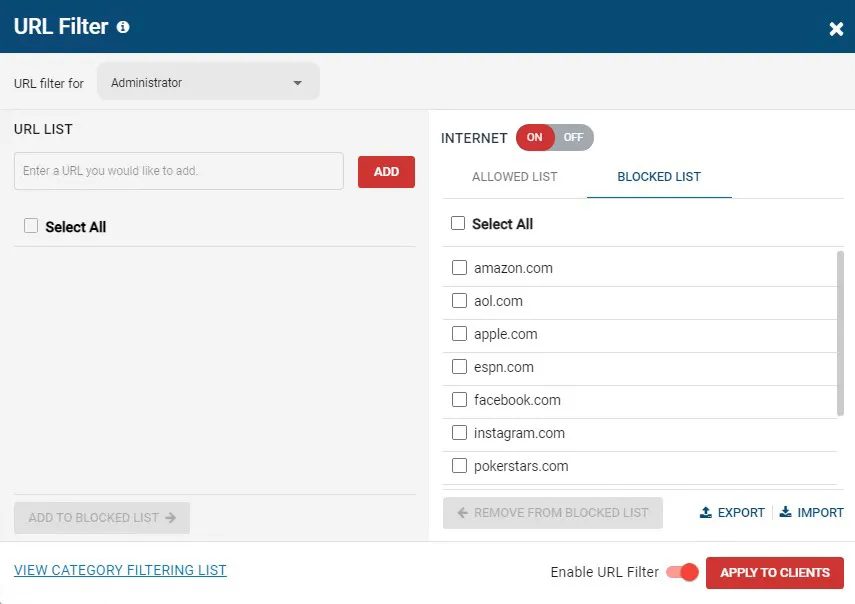
With the Allowed URLs List of the BrowseControl you can restrict internet access to only specific websites or exempt specific websites that are blocked by the Category Filtering feature.
With the Blocked URLs List you can block specific websites while allowing access to the rest of the internet.
BrowseControl’s category filtering database provides you with a convenient way to blacklist millions of websites across over 100 URL categories.
Start blocking access social media, porn, games, malicious sites such as malware or phishing sites, and more in just a few clicks!
Exposing students to the digital world comes with a responsibility to protect them. Students love BrowseControl because it gives them a safe working environment and prevents potential bad actors from interrupting their educational experience.
Enforce Acceptable Computer Use Policies
Block Bandwidth Hogs to Improve Network Availability
Reduce Distractions to Improve Employee Productivity
Protect Your Business From Compliance & Liability Risks
Protect Against Web Security Threats
Prevent Data Theft & Leakage
Join 100,000+ professionals across 55 countries.
90% of reviewers would recommend BrowseControl (average likelihood to recommend: 9 out of 10).
Block websites based on specific web content categories
Allowed list or Blocked list for specific URLs
Block specific Windows applications from launching
Prevent uploading and downloading based on file type
Close unused and high-risk TCP/UDP ports
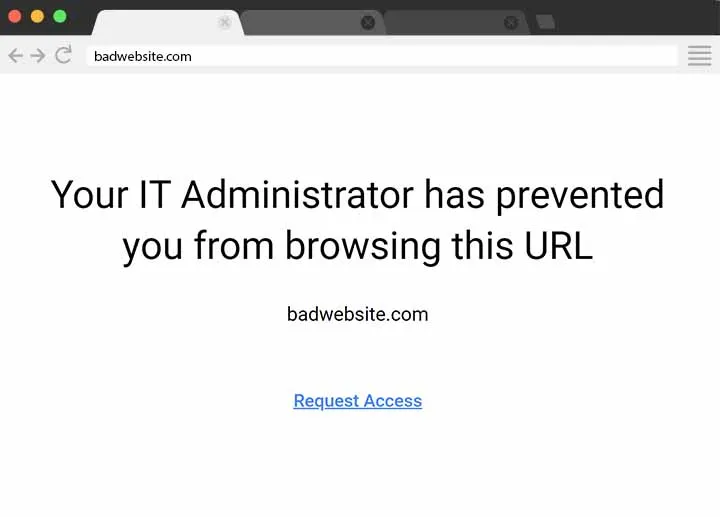
Display a customized warning message on blocked websites
Search engine filters prevent explicit results in search engines
Schedule internet access and control browsing based on time
Save time with a central admin console; optionally integrate Active Directory OUs or security groups
Protect your CurrentWare console with 2FA, passwords, privilege management, and more
Extend onsite security policies to computers running outside the corporate network
Database scaled for enterprise and large business operations using
Learn how to block a website with BrowseControl, CurrentWare’s URL filtering software. Easily restrict access to distracting, inappropriate, or unsafe sites on any web browser.
Frequently asked
No. CurrentWare’s software solutions are designed for businesses, schools, libraries, and other organizations. In other words, they are not suitable for parents that want parental control software for their child.
Yes. The client agent installed on the computers has the ability to block distracting and dangerous websites even if it does not have a connection with the CurrentWare Server.
The client agent stores and enforces BrowseControl’s restriction policies locally on the device.
The last known policies will continue to be enforced even if the endpoint loses connection to your network’s CurrentWare Server. This ensures that your policies remain in effect regardless of the network your employees or students use.
Note: If you wish to update policies or receive reports from client agents outside of the network they will need to be able to communicate with the CurrentWare Server.
Once a connection is reestablished you will receive the CurrentWare Client’s PC usage data and any policy updates will take effect.
Yes. Simply set the internet to “off” in BrowseControl and add the authorized intranet sites to the Allow List using their hostname or IP address.
Learn More: Block Internet & Allow Intranet with BrowseControl
Depending on the goals of your company you will block different websites.
To help keep your employees productive you may choose to block any site that could be considered a distraction, such as Facebook or TikTok. To improve security you may use the content category filtering features to proactively block websites that are known to be dangerous.
Need some ideas of what distractions to add to your website block list? Click here for a list of websites to block at work.
Yes. The CurrentWare Suite is supported on desktop computers, virtual machines (VMs), and servers running modern versions of the Windows operating system.
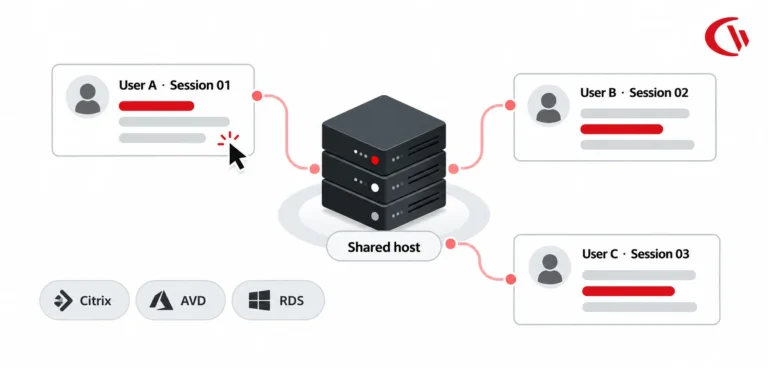
CurrentWare is a Citrix Ready partner; all of our solutions have gone through rigorous testing to ensure it is compatible with Citrix. You can install the CurrentWare Clients on your Citrix Workspace running Windows.
In addition, all CurrentWare components are compatible with Remote Desktop Services (RDS) or Terminal Servers (TS).
When restricting the web in Citrix with CurrentWare you can block a site on PC Mode to control the individual virtual machine or on User Mode to control specific employees across multiple devices and/or virtual machines.
Monitoring and managing employees in a Terminal Services environment works similarly.
The exception is that in a Terminal Server/Terminal Services environment the server will be registered as an individual endpoint; to apply granular policies for each user, department, or Organizational Unit you will need to use User Mode.
Learn More:
CurrentWare for Remote Desktop & Terminal Server
The CurrentWare Suite can be deployed on-premises or on a cloud platform of your choice. Both deployment option are compatible with remote workers with a few configuration changes.
Learn More:
Yes, BrowseControl is compatible with other proxy servers on your network.
Learn More: How to Use BrowseControl With a Proxy Server
CurrentWare is committed to the security of its platform, its users and their data.
For a complete overview of the security measures that CurrentWare has in place, check out the CurrentWare platform security overview page.
A URL, or Uniform Resource Locator, is a reference or address used to access resources on the internet. It is a string of characters that provides the means to locate a particular resource, such as a web page, document, image, or file, on the World Wide Web.
A URL typically consists of several components:
You can think of a URL as the address of a house on the internet. The scheme is like the street name (e.g., Main Street), the host is like the house number (e.g., 123), and the path is like the specific apartment or room within the house (e.g., Apartment 4B).
Here’s an example of a URL:
Scheme: https
Host: www.currentware.com
Path: /products/browsecontrol/category-filtering/
In this case, there are no specified query parameters or fragments. The URL represents a secure (HTTPS) connection to the host “www.currentware.com,” and the resource is located at the specified path “/products/browsecontrol/category-filtering/.”
URL filtering is a method used to control and manage access to websites based on their URLs (Uniform Resource Locators). It is a component of web filtering that allows administrators to define policies to either allow or block access to specific websites or categories of websites.
URL filtering is commonly employed in various environments, such as businesses, educational institutions, and public Wi-Fi networks, to enforce security, compliance, and productivity policies.
URL Categorization
URL filtering systems often rely on databases that categorize websites into different groups based on content, purpose, or other criteria. These categories can include topics like social media, gambling, adult content, or specific types of applications.
CurrentWare’s URL categorization tools include a website content category database that sorts domains across 100+ URL categories.
Policy Definition
Administrators define URL filtering policies based on the organization’s requirements. Policies may specify which categories of websites are allowed or blocked for users on the network. These policies can be tailored to meet security, productivity, or compliance goals.
All of BrowseControl’s web filtering tools can be customized based on groups of users or computers, including its URL filtering, web content filtering, and application blacklisting features. Updating policies takes only a few clicks from the central admin console, which can be accessed from the convenience of a web browser.
Real-Time URL Analysis
When a user attempts to access a website, the URL filtering system intercepts the request and checks the URL against the predefined policies and the categorization database. It evaluates whether the requested website falls within a blocked category or URL/domain.
If the website falls within a restricted category or URL/domain, the user is prevented from accessing it and is instead presented with a custom block page or redirected to a different URL, such as the organization’s acceptable use policy. Otherwise, the website loads as usual.
Logging and Reporting
URL filtering systems often log information about user web activity, including details about accessed websites, blocked content, and user behavior. This logging is valuable for compliance monitoring, security analysis, and reporting.
BrowseControl web filtering software operates from the same central console as BrowseReporter employee internet monitoring software. The modules can be purchased together to achieve the advanced control and visibility required to keep your organization safe and compliant.
Updates and Maintenance
As part of the URL filtering process, the URL filtering database needs regular updates to stay current with the evolving nature of the web. These updates may include new website categorizations, changes to existing categories, and additions or removals of specific websites.
CurrentWare’s URL filtering services ensure that its web category database is regularly updated to identify and categorize new websites as they emerge.

While URL filtering is a component of web filtering, the two terms are not entirely synonymous. Web filtering is a broader concept that encompasses various methods and techniques to control and manage access to content on the internet, while URL filtering specifically refers to the process of filtering or controlling access based on the URLs (Uniform Resource Locators) of websites.
Learn More: What’s the Best Way to Block Websites?
SPECIAL NOTE
BrowseControl’s web filtering tools are capable of blocking websites based on domain, URL, IP Address, URL keyword, and web content category.
Its integrated URL filter allows you to either whitelist specific URLs/domains to only allow access to specific websites or you can block specific URLs/Domains/Content categories.
The URL whitelist can also be used to allow access to websites that would otherwise by blocked based on their category (e.g. Block the social media category while allowing access to LinkedIn)
URL filtering and DNS filtering are both methods used to control and manage access to websites on a network, but there are a few key differences.
The traditional URL filtering process operates at the full URL level to block specific web pages (e.g. https://www.currentware.com//products/web-filtering-software/category-filtering/, while DNS filtering operates at the domain level (www.currentware.com) to block an entire website.
Here are the key differences between a URL and a domain:
CurrentWare’s internet management solutions include an integrated URL categorization tool that you can use to block access to and identify millions of websites across over 100 URL categories. The URL category database is constantly updated to address new websites as they emerge.
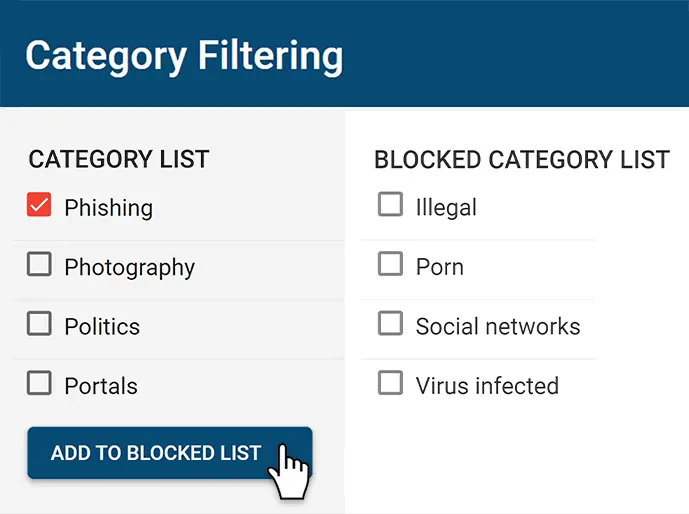
CurrentWare supports local database customization, allowing you to assign custom categories to websites that override the default categorizations provided.
You can also use the URL Category Lookup Tool to identify the content categories a given domain belongs to.
If you believe a website has been categorized incorrectly you can submit a URL for reclassification here.