
★★★★★ Capterra · Nov 2025
Productivity Monitoring Feedback
“Easy tracking of employee productivity. Seamless transition from person to person on the back end. Easy to update.”
We’ve updated our Subprocessor List, effective October 6, 2026. Please review the update to our Data Processing Addendum
Wondering how your team’s computers are being used? With CurrentWare’s Computer Monitoring Software, you can:
*No credit card required · 14-day free trial · For on-prem pricing, contact Sales
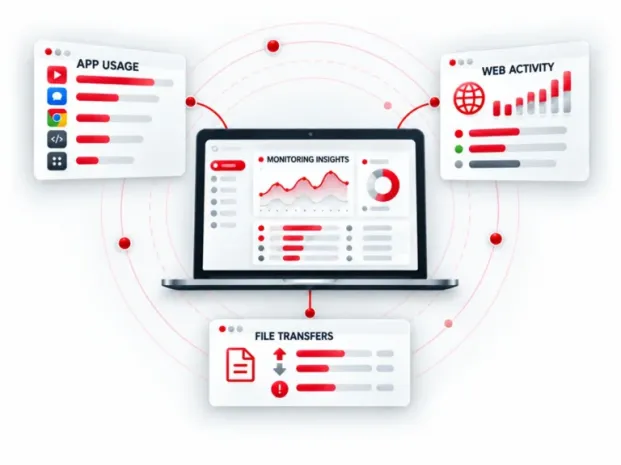

CurrentWare is a computer monitoring program that helps organizations understand how their devices are used: the files transferred, the websites visited, the apps opened and more.
In enterprise security frameworks, a Computer Monitoring Software is also referred to as User Activity Monitoring (UAM), and is an indispensable part of an organization’s security strategy that wants to keep a track of what’s happening on their company devices and identify any suspicious or malicious activity before it translates into a bigger problem. It serves three main purposes:
A computer monitoring system has three parts: an agent on each computer, a central console that stores the data, and the dashboards and alerts your team uses. Here is how they fit together:
An agent is installed on each company computer.
↓
Agent runs in the background and uses very little system resources.
↓
Agent tracks & gathers user activity (applications opened, sites visited, files shared, active & idle time)
↓
Agent gathers & stores the collected information in a central management console
↓
Authorized teams view dashboards, generate reports, and receive alerts if certain policies are violated, such as unauthorized file transfers or visits to blocked websites.
The best part? The agent never stops working.
Because the agent runs and collects data on the device, it keeps working whether the employee is in the office, at home, traveling, or on a VPN. That makes it employee laptop monitoring software as much as desktop monitoring, with the same visibility across all managed devices.
These terms, often used interchangeably, are different in their scopes.
| Computer monitoring software only focuses on device activity like apps, web browsing, file movements, and screenshots. | Employee monitoring software tracks websites & apps used by employees, active time vs. idle time, and file transfers across devices. | User Activity Monitoring tool focuses on security frameworks, primarily in cybersecurity and compliances, emphasizing on data loss prevention. |
|---|
CurrentWare’s Computer Monitoring Software tracks & records employee activity happening on company devices. We have categorized these activities into three:

Underutilized software costs businesses a staggering $34 billion per year! Monitor employee workstations to get genuine insights into application usage and make informed software asset management decisions.

BrowseReporter tracks the websites employees visit, time spent on each site, and search terms used. It automatically categorizes websites as productive, unproductive, or restricted, making browsing trends easy to understand.
Managers can view reports by employee, team, or organization, and set alerts for visits to high-risk websites or categories. Search history provides additional context to help IT and security teams investigate suspicious activity.

CurrentWare identifies when your employees are actively interacting with their device, and when the device is running but not being used. This way, it reports a clear breakdown of active vs. idle time for each employee.
This enables team managers to distinguish between real productivity gaps and schedule mismatches without any assumptions based on hours logged-in.

Improve data security with increased visibility into high-risk data transfers and USB activity.

Our employee computer monitoring software lets you monitor productive vs unproductive time and capture screenshots of your employees’ screens to see exactly what they are doing on their computers.

BrowseReporter’s Location Insights dashboard helps leaders make data-driven decisions about remote, in-office, and hybrid work.
Promote flexibility without sacrificing accountability with insights into how location flexibility affects employee engagement and productivity.

Improve business intelligence with advanced insights into web browsing, app usage, bandwidth consumption, productivity, and more!
Computer monitoring isn’t carried because of a lack of trust but to get data that backs decision-making. Organizations that function without any workforce visibility end-up making decisions based on assumptions and not evidence.
See how employees spend time across apps and websites with objective activity data. Identify productivity trends, remove workflow bottlenecks, and support more informed performance discussions.
Spot risky activity like large file transfers, unauthorized app usage, after-hours access, or data copied to external devices, helping IT investigate incidents before they become serious.
Track who accessed sensitive data, when, and what actions they performed. Detailed activity logs help support audits and meet compliance requirements like HIPAA, SOC 2, and GDPR.
Monitor activity consistently across office, remote, and hybrid employees. Understand work patterns, identify employees who need support, and ensure company systems are used appropriately.
In an organization, different teams may use the computer monitoring software for different purposes, depending on the requirements.
IT and security teams use computer monitoring to detect unusual activity, like unauthorized applications, large file transfers, or after-hours access. This helps them investigate security incidents, enforce IT policies, and identify unauthorized software across company devices.
HR teams use insights from the employee activity reports to gauge work patterns, reduced activity, or excessive non-work browsing, giving managers real data when they are counselling employees or having performance discussions, especially for remote employees.
Compliance teams use employee activity data to prepare for audits and show that company policies are being followed. Risk teams use the same data to monitor access to sensitive information and identify employee actions that could put the organization at risk.
In shared services environments like a BPO, contact center, financial services back-office, etc. managers & team leads use computer monitoring to measure productivity, workflow inefficiencies, and benchmark performance. The reports also help them analyze if there has been a consistent drop at a particular time, or trends that may impact overall process issues, or cause system slowdowns.
CurrentWare’s approach to computer monitoring is built on four principles: comprehensive data collection, on-premise data ownership, transparent deployment, and a modular product architecture that allows organizations to activate only the capabilities they need.
Unlike cloud-only monitoring tools, CurrentWare lets you keep all monitoring data on your own servers. Website activity, application logs, screenshots, and other user activity stay within your organization’s environment, giving you complete control over where your data is stored.
This is especially useful for organizations in regulated industries, government contracting, and any environment where data residency requirements or internal security policies prohibit storing sensitive user activity data in third-party cloud infrastructure. It helps businesses to better meet internal policies and support compliance with regulations such as GDPR and HIPAA.
BrowseReporter gives you the flexibility to monitor transparent or stealth monitoring depending on the situation. Most of the time, transparent mode makes sense, employees know it’s there, which keeps things fair and builds trust. But when something like an active investigation comes up, you can quietly switch to stealth mode to look closer, then switch back once it’s sorted
CurrentWare’s platform is a modular suite of three products, each addressable independently or deployed together:
You can start with BrowseReporter for monitoring and reporting, add BrowseControl to enforce policy, and deploy AccessPatrol when data loss prevention becomes a priority, without replacing the platform or migrating your data.
| BrowseReporter | BrowseControl | AccessPatrol |
|---|---|---|
| Computer monitoring and user activity reporting module. Tracks web browsing, application usage, active/idle time, screenshots, and generates the dashboards and reports described throughout this page. | Web filtering and access control. Enforces acceptable use policies by blocking categories of sites or specific URLs, with configurable schedules and override permissions for different user roles. | Endpoint data loss prevention. Monitors and controls USB and removable media activity, blocking unauthorized data transfers and logging all file copy events to external devices. |
CurrentWare is built for complex enterprise environments, supporting flexible deployment options and endpoint configurations commonly used by enterprises, healthcare organizations, and managed service providers.
CurrentWare is deployed on-premises by default, with all monitoring data stored on your own Windows Server. For organizations that prefer cloud hosting, the management console can also be deployed in a private cloud environment like Azure, AWS, or your own virtual machine, while keeping data under your control.
CurrentWare supports Citrix, Microsoft RDS, and other terminal server environments. It tracks activity at the individual user session level rather than the shared server, ensuring accurate monitoring even when multiple users work on the same server. This makes it well-suited for virtual desktop environments.
Employee computer monitoring is legal in the United States and most jurisdictions worldwide, but it is not unconditional. Employers who monitor computer activity must do so within a framework of notice, proportionality, and legitimate business purpose. This section outlines the key legal considerations; it is not legal advice, and organizations should consult qualified legal counsel when implementing a monitoring program.
Yes. In the United States, employers have broad legal authority to monitor activity on company-owned computers and networks. The Electronic Communications Privacy Act (ECPA) permits employer monitoring of electronic communications on employer-owned systems, and courts have consistently upheld employer monitoring policies when applied to company-owned equipment and network infrastructure.
The National Conference of State Legislatures (NCSL) provides a state-by-state overview of workplace privacy and monitoring laws. While federal law sets the baseline, several states have enacted additional requirements, most notably around employee notification.
Even where not legally mandated, best practice is to notify employees that their computer activity may be monitored. A written Acceptable Use Policy (AUP) or Employee Monitoring Policy, acknowledged in writing by employees, establishes the legal and organizational foundation for a monitoring program.
Beyond best practice, notification is legally required in several jurisdictions. Employers who monitor without disclosure may face liability under state law even where federal law permits the monitoring.
Disclaimer: This information is provided for reference only; it does not constitute legal advice. Reach out to local experts who are well versed in the legalities surrounding employee rights before you begin to implement your employee monitoring policy.
Other states are actively considering similar legislation. Staying current with NCSL’s tracker is the most reliable way to monitor the legislative landscape.
Disclaimer: The monitoring laws summarized above are intended as a general reference and may not reflect the latest legal developments. Organizations should consult legal counsel to ensure their employee monitoring practices comply with all applicable laws and regulations.
For regulated industries and global organizations, computer monitoring intersects with specific compliance obligations:
Disclaimer: This information is intended as a general reference and is not legal or compliance advice. Always consult a qualified professional to determine the requirements applicable to your organization.

Join 100,000+ professionals across 55 countries.


Across the whole CurrentWare Suite.
90% of reviewers would recommend BrowseReporter (average likelihood to recommend: 9 out of 10).
Tailored controls that help you meet industry standards, boost efficiency, and protect sensitive data across remote and in-office teams.
HIPAA-ready controls to protect PHI with USB management and insider-threat visibility.
Cybersecurity and policy enforcement aligned to NIST 800-171 and CMMC.
Keep client data protected, billable hours productive, and software costs in check.
Productivity monitoring and internet visibility for both the shop floor and back office.
Enforce access policies and protect sensitive financial data with audit-ready trails.
CIPA-compliant web filtering to qualify for E-Rate and keep students safe online.
Track unproductive web browsing and idle time to detect time-wasting
Deliver the monitoring, data-loss prevention, and web filtering your clients need, now with faster deployment, and easier management.
Discover how organizations use CurrentWare’s employee monitoring software to improve visibility, strengthen compliance efforts, and manage employee activity more effectively.

Endpoint Restriction to Protect CUI & FCI

Protect Controlled Unclassified Information

Increase the Maturity of Your ISO27K ISMS

HIPAA protects sensitive patient data

Critical Security Controls For Your Assessment

EU’s data protection and privacy law

Protect TCAs & BCSI From Insider Threats

Qualify for the FCC’s E-Rate Program
CurrentWare works alongside the identity, security, and directory tools you already use, including support for SAML, OIDC, and CEF standards. Cloud connectors are on the way.


Keep reading
The fast-growing company does not have a large IT team, resources dedicated to security, or weeks to deploy an enterprise…
When using employee computer monitoring software across the European Union (EU), companies have to find a balance between two legitimate,…
The location from which employees log in remained the same with the introduction of hybrid working; instead, it was the…
As hybrid and distributed work matures into 2026, enterprises' visibility challenges become more nuanced than whether an employee is logged…
Some workplace innovations can seem like a good idea in a management meeting and take a completely different shape when…
Frequently asked
Yes. U.S. employers have broad legal authority to monitor activity on company-owned computers and networks under the Electronic Communications Privacy Act (ECPA). Most states do not require employee consent for monitoring company-owned devices, though several, including New York and Connecticut, require prior written notice. Always consult the National Conference of State Legislatures (NCSL) tracker and qualified legal counsel for your specific jurisdiction.
Federal law does not require notification in most cases, but several states do, including New York (effective 2022) and Connecticut. Regardless of legal requirement, notifying employees via a written Acceptable Use Policy is widely considered best practice: it establishes a clear legal foundation, reduces employee grievances, and improves policy compliance. CurrentWare supports both transparent and optional stealth deployment modes.
A lightweight agent is installed on each monitored endpoint. It runs silently in the background and logs user activity like applications used, URLs visited, active and idle time, file transfers, and screenshots, then transmits that data securely to your CurrentWare console (on-premise or private cloud). Administrators access the data through dashboards and reports. NIST SP 800-137 describes the continuous monitoring framework that informs this approach.
CurrentWare tracks: application and software usage, web browsing and search activity, active vs. idle time, USB and removable media file transfers, screenshots on a configurable schedule, and location insights. All data is available per user, per device, and per team, with historical reporting and real-time dashboards.
BrowseReporter tracks apps, websites, idle time and screenshots. BrowseControl blocks sites and apps. AccessPatrol controls USB devices and logs file transfers. All three run from one agent and one console.
Yes. Because monitoring is agent-based at the endpoint level, it works regardless of what network the device is connected to, such as an office network, home broadband, or mobile hotspot. No VPN is required for monitoring to function. This makes CurrentWare equally effective for fully remote, hybrid, and office-based teams.
CurrentWare’s monitoring agent is fully supported on Windows. Mac compatibility varies by module; see Mac monitoring for current Mac support status and any platform-specific limitations before deployment planning.
Yes. CurrentWare is a Citrix Ready certified solution and supports monitoring in Citrix Virtual Apps and Desktops, Microsoft RDS, and terminal server environments. The agent monitors at the individual user session level, correctly attributing activity to each user rather than the shared host server. See the Coding Network case study for a real-world Citrix deployment example.
Both modes are available. In transparent mode, employees are aware they are being monitored, the recommended approach for standard productivity and compliance use cases, as it reinforces policy without creating an adversarial dynamic. Optional stealth mode is available for organizations that require covert monitoring for active investigations. CurrentWare recommends transparent deployment supported by a written monitoring policy.
Yes, on-premise deployment is a core architectural differentiator. The CurrentWare server installs on your own Windows Server infrastructure. All monitoring data is stored in your environment; no employee activity data is transmitted to CurrentWare’s servers. This makes it the preferred choice for organizations with data residency requirements, regulated data environments, or internal policies that prohibit third-party cloud storage of user activity data.
Yes. BrowseReporter captures screenshots on a configurable schedule (frequency set by the administrator). AccessPatrol logs all USB and removable media activity, including file copy events, device connections, and transfer volumes, and can block unauthorized transfers in real time in addition to logging them.
Computer monitoring focuses specifically on desktop and laptop activity: applications, web browsing, file operations, and screen capture. Employee monitoring is a broader term that may also include physical surveillance, badge access, phone recording, and GPS tracking. User Activity Monitoring (UAM) is the security-centric framing used in IT and cybersecurity contexts, emphasizing insider threat detection and audit trail generation. CurrentWare spans all three functions from a single agent.
CurrentWare starts at $12 USD per user per month. Volume pricing is available, and a free trial allows you to evaluate the full platform in your own environment before purchasing.
It doesn’t have to, and research suggests the implementation approach matters more than monitoring itself. Studies from Gartner and MIT Sloan indicate that employee responses to monitoring are strongly shaped by whether it is perceived as fair, transparently communicated, and tied to legitimate business goals rather than micromanagement. Monitoring programs that pair clear policy disclosure, focus on aggregate productivity data rather than granular surveillance of individuals, and use findings to support employees rather than penalize them tend to have neutral or positive morale effects.


