
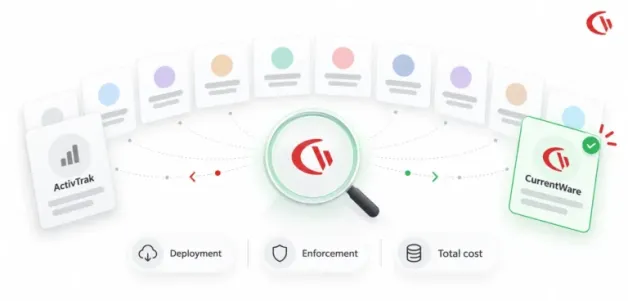
Looking for the best ActivTrak alternatives in 2026? We’ve created a list of the top 10 alternatives to ActivTrak with features, pricing, pros, and cons. The list of best ActivTrak alternatives in 2026 includes CurrentWare, Teramind, Veriato, InterGaurd, Insightful, DeskTime, HubStaff, TimeDoctor, Controlio, and KeepActive.
Which alternative is best for you depends on your budget, IT requirements, and purpose. Additionally, you need to answer three most important questions:
- Do you want on-prem deployment, or cloud-only?
- Do you want to enforce employee monitoring policy, or only want reports?
- How much of ActivTrak’s list price would you end up paying as add-ons?
This guide gives a clear breakdown of ActivTrak’s pricing with different plans, the reasons why companies look for ActivTrak’s alternatives, and how ten other ActivTrak alternatives compare on the features, pricing, and fit.
Note: Pricing for each tool was gathered as of latest in September 2026.
What is ActivTrak?
ActivTrak is a cloud-based workforce analytics and employee monitoring platform that tracks application and website usage, active versus idle time, and productivity patterns, then presents them as dashboards for managers and HR leaders. It positions itself as a work intelligence tool rather than a surveillance product, and its strongest features sit in workload balance, focus measurement, burnout risk, and capacity planning. Founded on a lightweight agent for Windows and macOS.
ActivTrak classifies roughly 95% of common activity as productive or unproductive out of the box, which is why it deploys quickly and needs very little IT involvement. It serves teams from three people to several thousand, with the deeper analytics gated to the higher tiers.
ActivTrak Plans & Pricing in 2026
| Plan | Price (per user/month, billed annually) | Users | Data history | Key inclusions | Notable exclusions |
|---|---|---|---|---|---|
| Free | $0 | Up to 3 | 30 days | Activity log, productivity reports, top apps, websites and categories, automatic classification, alarms | Real-time visibility, app and website tracking, exports, SSO/MFA, silent deployment, all add-ons |
| Essentials | $10 | Unlimited (5-license minimum) | 6 months | Productivity classification, idle detection, real-time dashboards, app and website tracking, SSO/MFA, report exports (50K row cap) | Productivity goals, workload balance, benchmarks, screenshots, API |
| Essentials Plus | $15 | Unlimited (5-license minimum) | 6 months | Everything in Essentials plus productivity goals, focus time and context-switching metrics, workload balance, exception reporting, work location insights, benchmarks | Burnout detection, AI coaching, cross-team comparisons, screenshots |
| Professional | $19 | Unlimited (5-license minimum) | 12 months | Everything in Essentials Plus plus team health and burnout risk detection, AI-powered coaching, capacity and workforce planning, cross-team and cross-location comparisons | Screenshots (add-on), API (add-on), keystroke logging, session video recording, mobile monitoring |
| Enterprise | Custom quote | Custom | Custom | Everything in Professional plus enterprise governance, onboarding, and custom terms | Published pricing |
What ActivTrak Actually Costs You
- Three core capabilities are sold as add-ons. Screen Details costs $2 per user/month and is the only way to access screenshots, live screen views, full URLs, title bars, website blocking, and certain alarm actions. It is not included in any tier, including Professional. ActivConnect API access for BI tools and data export costs another $3 per user/month. Extra data history costs $1 per user/month for each additional year, up to three years.
- Every paid plan has a 5-license minimum. A three-person team on Essentials still pays for five seats, which puts the minimum annual spend at $600 regardless of headcount.
- Paid plans are annual only. There is no month-to-month option on any paid tier. License reductions, downgrades, and cancellations can only be made at renewal.
- Paid support is required above 50 licenses. Purchases of more than 50 seats require a Premier or Signature support plan. That pricing is not published on the pricing page.
- ActivTrak is a cloud-only SaaS product. There is no on-premise edition, self-hosted option, or private cloud tenancy.
Best ActivTrak Alternative by Use Case
Different requirements call for different tools. These quick answers match the most common buying scenarios with one recommendation each.
- Best overall ActivTrak alternative: CurrentWare, because it is the only platform here that offers on-premise, self-managed cloud, and vendor-hosted deployment while combining productivity analytics, web filtering, and device control in a single agent.
- Best on-premise / self-hosted ActivTrak alternative: CurrentWare, which runs entirely on customer-controlled infrastructure without requiring monitoring data to pass through a vendor cloud.
- Best ActivTrak alternative for small business: DeskTime, which starts at $6.42 per user/month, has no meaningful seat minimum, and requires very little administration.
- Best ActivTrak alternative for remote teams: Insightful, whose automated time mapping and US, EU, and Canadian data residency options suit distributed teams that need analytics without invasive capture.
- Best ActivTrak alternative for enterprises: Teramind, which combines insider risk detection, content-aware DLP, and SIEM integration and supports cloud, private cloud, and on-premise deployment.
- Best ActivTrak alternative with screenshots: CurrentWare, because screenshot monitoring with OCR text search is included in BrowseReporter rather than sold as a $2 per user/month add-on.
- Best ActivTrak alternative for insider threat detection: Veriato, whose daily risk scoring, behavior analytics, and psycholinguistic signals are designed for formal insider risk programs.
- Best ActivTrak alternative for workforce analytics: Insightful, which takes a similar analytics-led approach to ActivTrak at a lower entry price and includes screenshots in its base plan.
- Best free ActivTrak alternative: Hubstaff, the only tool in this comparison with a permanent free tier, although it is limited to one user with basic time tracking.
- Best open-source ActivTrak alternative: There is no credible open-source equivalent with comparable reporting, support, and compliance coverage. Teams that want control over their own data should consider a self-hostable commercial product such as CurrentWare, Controlio, or KeepActive.
A Quick Comparison of 10 Best ActivTrak Competitors (Free and Paid)
| Tool | Primary Use Case | Key Strength | Core Features | Starting Price | Free Plan / Trial | Deployment | Best For | Capterra / G2 |
|---|---|---|---|---|---|---|---|---|
| CurrentWare | Monitoring plus endpoint enforcement | Deployment flexibility with productivity, filtering, and DLP in one agent | Activity and productivity tracking; screenshots with OCR search; URL, category and app blocking; USB control and DLP; power management and logon tracking | $12/user/mo (BrowseReporter), $20/user/mo (full suite), annual | 14-day trial, 10 computers, no card | On-premise, self-managed cloud, or vendor-hosted cloud | Regulated, air-gapped, and IT-led environments | 4.5 / N/A |
| Insightful (formerly Workpuls) | Workforce analytics | Automated time mapping without manual timers | Time mapping to projects; app, web and idle tracking; screenshots; productivity scoring; HRIS integrations | $6.40/seat/mo annual | 7-day trial | Cloud; self-hosted and private cloud on Enterprise | Remote and hybrid teams wanting analytics without surveillance | 4.8 / 4.6 |
| Hubstaff | Time tracking and payments | Time-to-pay workflow with GPS for field teams | Time tracking and timesheets; activity levels; screenshots; GPS and geofencing; scheduling; payroll and invoicing | $4.99/seat/mo annual, 2-seat minimum | Free plan for 1 user; 14-day trial | Cloud only | Hourly, field, and contractor-heavy teams | 4.6 / 4.4 |
| Time Doctor | Billable time and proof of work | Project and client billing reporting with video capture | Time tracking; screenshots and video recording; web and app reporting; distraction alerts; 60+ integrations; payroll | $6.70/user/mo annual | 14-day trial, no free plan | Cloud only | BPOs and agencies billing by tracked hours | 4.5 / 4.4 |
| Teramind | Insider risk and DLP | Deepest forensic evidence and rule-based enforcement | Session video; keystroke logging; OCR; content-aware DLP; behavior rules with automated actions; risk scoring; SIEM | $14/user/mo annual, 5-seat minimum | Free trial, no free plan | Cloud, private cloud, or on-premise | Security-led deployments where data exfiltration is the concern | 4.7 / 4.6 |
| InterGuard | Monitoring and investigations | Broadest device coverage including mobile and Chrome OS | Keyword-triggered screenshots; email, chat and social monitoring; DLP alerts; remote lockdown and file retrieval; web filtering | ~$25/user/mo cloud list, lower on volume tiers | 7-day trial | Cloud-hosted or on-premise | Mixed device fleets and offboarding investigations | 3.9 / N/A |
| Controlio | Screen recording and live view | Three deployment models from one vendor | Live screen view; continuous recording; screenshots; keystroke logging; site, app and USB blocking; real-time alerts | $6.67/user/mo annual | 14-day trial, no card | Cloud, on-premise (10-user minimum), or managed private cloud | Teams needing live oversight with a self-hosting option | 4.7 / N/A |
| DeskTime | Automatic time tracking | Simplicity and low admin overhead | Automatic time tracking; productivity categorization; project time; optional screenshots; absence calendar and shift scheduling | $6.42/user/mo annual | 14-day trial, no card | Cloud only | Small teams needing defensible timesheets | 4.5 / 4.5 |
| Veriato | Enterprise insider risk | Behavior analytics with daily risk scoring | UBA and risk scoring; screen recording; keystroke, email and file logging; psycholinguistic analysis; anomaly detection; forensic export | Quote only | Demo and trial on request | Cloud or on-premise | Enterprises and government running formal insider risk programs | N/A / 4.3 |
| KeepActive (formerly Kickidler) | Live screen oversight | Low-cost live view and session video at scale | Multi-screen live view; continuous video recording; keystroke logging; violation detection; time tracking; DLP tier | $5/user/mo (Time Tracking tier) | Free trial, no free plan | Cloud or on-premise, perpetual license option | Budget-conscious teams wanting live screens and recorded video | 4.6 / N/A |
Why Businesses Look for ActivTrak Alternatives
Most teams move away from ActivTrak for one of two reasons. Either they have a deployment or data residency requirement the platform cannot meet, or the final cost ends up 25% to 75% higher than the price they saw on the pricing page. A smaller group leaves because they need endpoint security and enforcement alongside productivity data and would otherwise have to buy a second product.
1. No On-Premise or Self-Hosted Deployment Option
ActivTrak does not offer an on-premise, self-hosted, or private cloud edition. Monitoring data is collected by an agent and stored in ActivTrak’s cloud. There is no deployment model that keeps the data entirely inside your own network.
That can rule ActivTrak out for air-gapped networks, classified environments, defense contractors working under CMMC or NIST 800-171, and organizations with data sovereignty or residency requirements that require activity logs to stay in-country or on customer-controlled infrastructure.
The available workaround, streaming data into a customer-owned BigQuery instance, requires the ActivConnect add-on and still sends the data through ActivTrak’s cloud first. If self-hosting is a hard requirement, the decision is made before features or price even enter the discussion.
2. Add-On Pricing Inflates the Real Cost
Screenshots, API and BI access, and extended data retention are all priced separately from the core plan. As a result, the published per-user rate is often not what a fully configured deployment actually costs.
Take a 50-seat Professional deployment. The base license is 50 × $19 × 12 = $11,400 per year. Add Screen Details for screenshots at $2 per user/month ($1,200), ActivConnect API access at $3 per user/month ($1,800), and two extra years of data history at $1 per user/month ($1,200).
The total comes to $15,600 per year. That is 37% above the list price and does not include the Premier or Signature support plan required at that license count, which is not publicly priced.
The same calculation on Essentials takes a $6,000 deployment to $10,200.
3. Limited Screenshot and Session-Evidence Capability
Screen capture is an add-on rather than a core feature, and ActivTrak does not offer session video recording at any tier, including Enterprise.
Screenshots, live screen viewing, full URL visibility, and title bar details all require the Screen Details add-on at $2 per user/month. For HR investigations, dispute resolution, compliance audits, or fraud reviews, screenshots taken at intervals may not provide enough evidence. Teams that need continuous session playback have to consider tools such as Teramind, Veriato, Controlio, or
KeepActive, which offers video recording as a standard capability.
ActivTrak also does not log keystrokes or monitor mobile devices, so the amount of evidence it can provide is intentionally limited.
4. Productivity Analytics Over Security Depth
ActivTrak is designed around productivity measurement rather than endpoint security. It does not provide USB or peripheral device control, meaningful content-aware DLP, or extensive insider-threat capabilities beyond activity-based alarms.
An employee can copy a client database to a USB drive, upload a source code repository to personal cloud storage, or print a confidential contract without ActivTrak blocking the action. Organizations that need both workforce visibility and endpoint protection therefore have to maintain two products, two agents, and two consoles.
Suites such as CurrentWare and Teramind combine device control and DLP with monitoring in the same agent. That can be less expensive and is simpler to administer than running a monitoring platform alongside a separate DLP stack.
5. Web Filtering and Enforcement Are Basic
ActivTrak is primarily a reporting tool. Website blocking is available only through the Screen Details add-on, and it does not extend to category-level policies, application blocking, port control, or download restrictions. If you only need visibility, that may be enough. If you need control, it is not.
Schools, healthcare providers, financial firms, and manufacturers often need to block entire content categories, restrict specific applications, prevent access to unapproved AI tools, apply different rules by department or time of day, and demonstrate to auditors that those policies are actually enforced. Dedicated filtering modules such as CurrentWare’s BrowseControl handle URL, category, application, port, and schedule-based blocking as core functionality rather than as an add-on.
6. Data Retention Limits on Lower Tiers
Data history is limited by plan: 30 days on Free, 6 months on Essentials and Essentials Plus, and 12 months on Professional. Additional history costs $1 per user/month for each extra year, up to a hard maximum of three years.
For regulated industries, that can become a compliance issue rather than a minor inconvenience. Financial services firms operating under SEC and FINRA recordkeeping rules, healthcare organizations retaining access logs under HIPAA, and government contractors maintaining audit trails may need five to seven years of records.
A three-year ceiling means organizations must either archive data through ActivConnect or accept a gap. If a paid subscription expires, the account reverts to the Free plan and only the most recent 30 days remain accessible.
7. Contract Terms, Minimums, and Support Gating
All paid plans are annual-only and have a 5-license minimum. Mid-term changes are not permitted, and responsive support is gated behind paid tiers that become mandatory above 50 licenses.
In practice, this means a team that buys too many seats in January cannot reduce them until renewal. A company piloting with three users still pays for five. A 60-seat deployment must purchase Premier or Signature support at a price that is quoted rather than published.
Renewal contracts also commonly carry 5% to 10% annual escalators unless multi-year fixed pricing is negotiated in advance. None of these terms are hidden, but they create a very different commitment from vendors that offer monthly billing or two-seat minimums.
ActivTrak remains a strong fit for cloud-first organizations with 50 or more employees where HR or operations owns the deployment, the goal is workload balance and burnout prevention rather than security, and there is no requirement to keep data in-house. If that describes your organization, the alternatives below may solve problems you do not actually have.
Top ActivTrak Alternatives in 2026: Market Overview
The ten alternatives fall into four broad groups: security-led monitoring suites, productivity analytics platforms, time trackers with monitoring features, and recording-first tools. Identifying the group that matches your needs can eliminate most of the shortlist before you start comparing individual products.
Category A: Employee Monitoring With Security and Enforcement Built In
These platforms combine activity visibility with the ability to block, restrict, and investigate. They are a better fit for IT and security teams that need to act on the information they collect rather than simply report on it.
1. CurrentWare
CurrentWare is a four-module employee monitoring and endpoint security suite made up of BrowseReporter for activity and productivity tracking, BrowseControl for web and application filtering, AccessPatrol for device control and data loss prevention, and enPowerManager for power management and logon tracking.

All four modules use the same agent and console. Organizations can license only what they need and add other modules later without redeploying endpoints. It is used by IT and security teams across finance, healthcare, legal services, manufacturing, education, and government, and reports 100,000+ professionals in 55 countries.
CurrentWare is a strong ActivTrak alternative for organizations that want monitoring data to remain within their own infrastructure while also getting productivity reporting and policy enforcement from one platform.
Key Features
- Website, application, and active versus idle time tracking with schedule adherence reporting
- Screenshot monitoring with OCR text search across captured screens
- Application allowlisting to restrict & monitor productive apps
- URL, category, application, and port filtering with time-based rules and custom block pages
- USB and peripheral device blocking with file transfer restrictions
- DLP alerts and reports covering file copy, transfer, and removable media activity
- Bandwidth usage reporting and PC power management with logon and session tracking
- SIEM connectivity, Power BI templates, SSO, and 2FA through the Premium add-on package
Deployment: On-premise, self-managed cloud on your own AWS, Azure, or private server, or CurrentWare-hosted cloud.
Pros:
- The only platform in this list offering on-premise, self-hosted cloud, and vendor-hosted deployment from the same product
- Productivity analytics, web filtering, and device control run through one console, eliminating the need for a second vendor and console
- Data ownership, residency, and retention remain under customer control with self-hosted deployments
- Per-module pricing is published rather than quote-gated, and modules can be licensed selectively per machine
- Includes a full-access free trial of 14-days with no credit card requirement.
- Volume discounts start at 100 licenses, with a 10% discount for education and nonprofit organizations
Cons:
- Windows-first agent coverage. macOS support arrived in version 12 but is still new, and there is no Linux agent.
- Fir enterprise level plan with more hands-on security, other competitors like Teramind would work better.
Pricing Model: BrowseReporter starts at $12 USD per user/month and the full CurrentWare Suite at $20 USD per user/month, billed annually. BrowseControl and enPowerManager are $6 USD per user/month each, while AccessPatrol is $12 per user/month. On-premise licensing and the Premium add-on package are quoted by sales. A 14-day free trial requires no credit card.
Best for: IT and security teams that need productivity visibility and endpoint control in one platform, with the option to keep all data on their own infrastructure.
2. Teramind
Teramind is a user activity monitoring and insider risk platform that combines continuous session recording, rule-based automated responses, and content-aware data loss prevention. It is known for the depth of its evidence, including video playback, keystrokes, OCR of on-screen content, email, and file transfer activity.

Typical buyers include security teams in financial services, healthcare, government, and business process outsourcing.
Teramind is a good fit for organizations replacing ActivTrak because they need insider threat detection and active enforcement rather than productivity dashboards.
Key Features
- Continuous session video recording with searchable playback
- Keystroke logging and OCR of on-screen content
- Content-based DLP rules covering file, email, clipboard, and print activity
- Behavior rules with automated responses including block, warn, redirect, and lockout
- User risk scoring and anomaly detection
- SIEM integration and forensic audit reporting
Deployment: Cloud (SaaS), private cloud, or on-premise.
Pros:
- The deepest evidence capture of any platform in this comparison
- Built-in enforcement means policy violations can be blocked rather than simply logged
- On-premise and private cloud options support regulated and sovereign environments
- Compliance mapping for HIPAA, GDPR, PCI DSS, and ISO 27001 is well documented
Cons:
- The most expensive option per seat at the UAM and DLP tiers, at roughly double to triple ActivTrak Professional
- The admin console has a steep learning curve, and reviewers commonly report needing dedicated administrator time during the first month
- Its capture depth is more invasive than many workplace cultures or works councils will accept
Pricing Model: Starter is $14, UAM is $28, and DLP is $32 per user/month, billed annually. There is a 5-seat minimum, with Enterprise priced on request. Annual billing discounts are roughly 8% compared with monthly billing. On-premise is priced per endpoint and quoted separately, with volume discounts beginning around 250 seats.
Best for: Security-led deployments where insider risk and data exfiltration are the primary concerns.
#3 Veriato
Veriato is a workforce behavior analytics and insider risk platform built around two products: Veriato UAM for user activity monitoring and Veriato Cerebral for insider risk management, user behavior analytics, and daily risk scoring.

The company has developed monitoring software since 1998 and is known for psycholinguistic analysis designed to flag disengagement and behavioral change. Its customers typically include enterprises, government agencies, and regulated firms across more than 70 countries.
Veriato is worth considering when an ActivTrak replacement needs to support formal investigations and risk scoring at enterprise scale.
Key Features:
- User behavior analytics with company-wide daily risk scoring
- Continuous screen recording and screenshot capture
- Keystroke, email, chat, and file activity logging
- Psycholinguistic sentiment analysis for disengagement and insider risk signals
- Anomaly detection with configurable alert thresholds
- Investigation workflows and forensic export tooling
Deployment: Cloud or on-premise.
Pros:
- One of the more mature insider risk feature sets available, refined over more than two decades
- Risk scoring is designed for security analysts rather than line managers
- On-premise deployment supports regulated, defense, and government environments
- Scales to thousands of endpoints and bills per user rather than per device
Cons:
- Pricing is not published, so budgeting requires a full sales process before the actual cost is known
- Reviewers commonly report implementation timelines of one to two weeks
- Analytics are security-oriented, making it less suited to everyday productivity management, and iOS devices are not supported
Pricing Model: Not published. Pricing is quote-based and tiered by volume, with per-user rates falling as license counts increase. Third-party listings cite roughly $25 per user/month on monthly billing and around $15 per user/month on annual terms, but these figures should be confirmed directly with Veriato rather than used for budgeting.
Best for: Enterprises and government agencies running formal insider risk programs with dedicated security teams.
#4 InterGuard
InterGuard is an employee monitoring and data loss prevention platform from Awareness Technologies. It combines activity recording with web filtering, remote endpoint lockdown, and investigation tools.

It supports Windows, macOS, Chromebooks, terminal servers, iOS, and Android, giving it one of the broadest device footprints in this comparison. It is used by organizations ranging from small businesses to large enterprises, particularly where offboarding risk and internal investigations are key concerns.
InterGuard fits teams replacing ActivTrak that need mobile and Chrome OS coverage alongside desktop monitoring.
Key Features:
- Keyword-triggered screenshot capture
- Email, instant message, and social media monitoring
- File activity monitoring with DLP alerts
- Remote endpoint lockdown and remote file retrieval
- Web filtering and application blocking
- Time tracking with configurable productivity ratings and GPS location
Deployment: Cloud-hosted or on-premise.
Pros:
- The broadest device coverage in this comparison, including mobile operating systems and Chrome OS
- Remote lockdown and file recovery are useful for offboarding and incident response
- Can operate visibly or silently depending on policy
- Modules can be licensed individually rather than as a mandatory bundle
Cons:
- The interface is dated and cluttered compared with newer platforms, and its 3.9 Capterra score is the lowest in this comparison
- No live video screen recording, which limits its usefulness for evidentiary use cases
- Published pricing varies across directories, while on-premise deployments require a quote
Pricing Model: Cloud-hosted list pricing is cited at around $25 per user/month, with tiered annual rates published at roughly $60 per user/year for 2 to 10 users and $54 per user/year for 11 to 25 users. Monthly plans have a five-user minimum and annual plans have a two-user minimum. On-premise and enterprise deployments are quoted. A 7-day trial is available.
Best for: Distributed teams with mixed device fleets and recurring investigation or offboarding requirements.
Category B: Productivity and Workforce Analytics
These platforms are the closest like-for-like alternatives to ActivTrak. They are aimed at managers and HR leaders who want to understand how work happens without adding extensive enforcement or security tooling.
#5 Insightful (formerly Workpuls)
Insightful is a workforce analytics and employee monitoring platform focused on automated time mapping, productivity scoring, and activity tracking. It was rebranded from Workpuls in April 2022.
The platform classifies application and web activity into projects and tasks without requiring employees to start and stop timers. It also takes a deliberate privacy approach by excluding keystroke logging, email content, and webcam capture. It serves more than 5,800 organizations, with a concentration in IT, consulting, outsourcing, and professional services.
Insightful is a natural ActivTrak alternative for teams that want a similar analytics-led approach at a lower entry price, with screenshots included rather than charged separately.
Key Features:
- Automated time mapping of activity to projects and tasks
- Application, website, and idle time tracking with configurable productivity classification
- Screenshot capture and second-by-second activity timelines
- Workforce and workflow analytics dashboards with benchmarking
- HRIS and project management integrations across 50+ tools
- Data residency options in the United States, European Union, and Canada
Deployment: Cloud, with self-hosted and private cloud options available on Enterprise.
Pros:
- Lower entry price than ActivTrak Essentials, with screenshots included in the base plan
- No seat minimums, so small teams pay only for the seats they use
- Explicit limits on invasive capture can make internal approval easier
- Stronger HRIS integration coverage than most direct competitors
- Regional data residency options support GDPR and similar requirements
Cons:
- No web filtering, device control, or DLP enforcement
- Self-hosting is limited to the Enterprise tier, leaving smaller regulated teams on cloud
- Screen recording, on-demand screenshots, and workspace security are available as add-ons at roughly $4 per seat each
Pricing Model: Productivity Management is $6.40, Time Tracking is $8, and Process Improvement is $12 per seat/month, billed annually. Enterprise is priced on request. Monthly billing is available at higher rates. Each device an employee uses counts as one seat, while admin, manager, and client accounts are not billed unless they are also tracked. A 7-day free trial is included.
Best for: Remote and hybrid teams that want workforce analytics without surveillance-grade capture.
#6 DeskTime
DeskTime is an automatic time tracking and productivity analysis tool that records computer time without manual timers and categorizes applications and websites as productive, unproductive, or neutral.
It is known for its simplicity, light administrative requirements, and built-in absence and shift management. Around 78% of its reviewer base consists of small businesses, particularly in IT services, software, and financial services.
DeskTime works as an ActivTrak replacement when the goal is defensible time data with a productivity layer rather than deep monitoring.
Key Features:
- Fully automatic time tracking with idle detection
- Productivity categorization of applications and URLs
- Project and task time tracking with custom reports
- Optional automatic screenshots
- Absence calendar, shift scheduling, and booking
- Payroll-ready exports and calendar integrations
Deployment: Cloud only.
Pros:
- One of the quickest tools here to deploy, with minimal ongoing administration
- Time tracking, attendance, and scheduling are bundled rather than split across tiers
- Priced below ActivTrak at comparable capability levels
- Consistently well rated for usability on Capterra and G2
Cons:
- No web filtering, device control, or DLP
- Cloud-only deployment rules it out for organizations with data residency or self-hosting requirements
- Analytics are shallower than ActivTrak Professional, with no burnout risk detection or capacity planning
Pricing Model: Pro is $6.42 and Premium is $9.17 per user/month when billed annually, or $7 and $10 respectively when billed monthly. Enterprise is custom priced. Annual billing includes one free month. A 14-day free trial requires no credit card, and the single-user free Lite tier has been discontinued.
Best for: Small teams that need accurate timesheets and a light productivity signal without running a broader monitoring program.
Category C: Time Tracking With Monitoring Features
These tools start with hours worked rather than activity patterns. They are a better fit when tracked time feeds payroll, client invoices, or project budgets.
#7 Hubstaff
Hubstaff is a time tracking and workforce management platform that combines timesheets, activity levels, screenshots, GPS location, scheduling, and payroll.

It supports field and mobile teams as well as desk-based employees, with geofencing and job site tracking. It is widely used by agencies, construction and field service firms, staffing companies, and distributed teams that pay contractors by the hour.
Hubstaff is a better ActivTrak alternative when hours worked and payments matter more than behavioral analytics.
Key Features:
- Automatic and manual time tracking with approvals and timesheets
- Activity levels with application and URL tracking
- Screenshot capture with configurable frequency
- GPS tracking, geofencing, and job sites through the Locations add-on
- Scheduling, attendance, and time off management
- Payroll, invoicing, and integrated contractor payments
Deployment: Cloud only.
Pros:
- Lowest entry price in this comparison at $4.99 per seat/month
- Only tool here with a permanent free tier, although it is limited to one user
- Payroll and invoicing are built in rather than integrated
- Supports field teams through GPS and geofencing
- Two-seat minimum is the smallest paid commitment among the vendors listed
Cons:
- Cloud only, with no self-hosted or private cloud option
- Workforce analytics, unlimited screenshots, and GPS sit behind the Team tier or paid add-ons, so a fully featured seat can reach $15 to $20 rather than $4.99
- No web filtering, device control, or DLP
Pricing Model: Starter is $4.99, Grow is $7.50, Team is $10, and Enterprise is $25 per seat/month, billed annually. All paid plans except Enterprise have a 2-seat minimum. Locations starts at around $3.33 per seat/month and extended data retention at around $1.67 per seat/month. A free plan covers one user, and a 14-day trial requires no credit card.
Best for: Hourly, field, and contractor-heavy teams where time-to-payment is the main workflow.
#8 Time Doctor
Time Doctor is a time tracking and workforce analytics platform built around tracked hours, screenshots, and distraction alerts.

It is widely used in business process outsourcing, where proof of work supports client billing. It also offers video screen recording, something ActivTrak does not provide at any tier. Its reviewer base skews toward small businesses, BPOs, education management, and consumer services operations.
Time Doctor is a practical ActivTrak alternative for organizations that bill clients based on tracked time and need project-level evidence to support those hours.
Key Features:
- Time tracking with idle detection and real-time distraction alerts
- Screenshots with optional video screen recording
- Web and application usage reporting
- Project, task, and client time allocation
- Payroll processing and 60+ integrations
- Executive dashboards, SSO, and unusual activity detection
Deployment: Cloud only.
Pros:
- Strong project, client, and billing reporting for agencies and outsourcers
- Video screen recording is available, unlike ActivTrak
- One of the largest integration libraries in the category
- Clear manager-facing distraction and productivity workflows
Cons:
- Cloud only, with no self-hosted option
- Heavy feature gating. SSO, video recording, and Benchmarks AI are add-ons on lowertiers, and combining two add-ons on Standard can cost more than upgrading to Premium
- No permanent free tier, and annual contracts are non-refundable once committed
- No web filtering, device control, or DLP
Pricing Model: Basic is $6.70, Standard is $11.70, and Premium is $16.70 per user/month when billed annually, or $8, $14, and $20 when billed monthly. Enterprise is quoted separately. Annual billing saves roughly 16.6%. Add-ons on Basic and Standard include video screen recording at around $3 per user/month and SSO at around $200 per account/month. A 14-day trial unlocks all features.
Best for: BPOs and agencies that bill by tracked hours and need defensible proof of work.
Category D: Screen Recording and Live View
These tools prioritize visual evidence over analytics. They are a better fit for contact centers, investigations, and environments where seeing the actual session matters more than summarizing activity.
#9 Controlio
Controlio is an employee monitoring platform built around live screen viewing and continuous screen recording, with activity tracking, keystroke logging, and behavioral alerts layered on top.

It offers cloud, on-premise, and managed private cloud deployment from a single vendor, with AWS S3 storage for recording archives. It is typically used by compliance-driven and security-focused teams that want visual evidence without the pricing of a broader enterprise DLP platform.
Controlio is a fit for teams leaving ActivTrak specifically because they need live screen viewing and retrievable recorded sessions.
Key Features:
- Live screen viewing with team-wide multi-screen view
- Continuous screen recording with searchable archives
- Screenshot capture and activity timelines
- Website, application, and USB device blocking
- Real-time behavioral alerts and mouse jiggler detection
- Active Directory sync on on-premise deployments, plus SSO and REST API
Deployment: Cloud, on-premise with a 10-user minimum, or managed private cloud.
Pros:
- Combines live viewing and a recorded session archive, neither of which ActivTrak offers
- Provides three deployment models from one vendor, including managed private cloud
- Low entry price relative to its capabilities
- Configurable retention and S3-backed storage on self-hosted deployments
Cons:
- Invasive by design, which can conflict with transparency-led monitoring policies and make employee acceptance more difficult
- Limited native integrations and no dedicated mobile application
- Feature depth creates a learning curve for smaller teams
Pricing Model: Basic is $6.67 and Advanced is $9.99 per user/month when billed annually. Enterprise is custom priced and aimed at deployments of 100+ users. Licenses apply to concurrent monitored sessions, while dashboard admins, managers, and employees are not separately licensed. Licenses can be added mid-term with prorated pricing. A 14-day free trial requires no credit card.
Best for: Teams that need real-time screen oversight and session evidence with the option to self-host.
#10 KeepActive (formerly Kickidler)
KeepActive is an employee monitoring and workforce analytics tool rebranded from Kickidler in November 2025. It is built around real-time screen viewing, continuous video recording, keystroke logging, and violation detection.

The platform is known for displaying multiple live screens at a low per-seat cost. The rebrand shifted its marketing toward analytics while retaining the underlying monitoring architecture. Its user base skews toward small businesses, contact centers, and public institutions.
KeepActive is the low-cost option for teams replacing ActivTrak when continuous live screen oversight is the actual requirement.
Key Features:
- Real-time multi-screen live view across the fleet
- Continuous screen video recording with playback
- Keystroke logging
- Productivity and efficiency analysis with time tracking
- Violation detection and configurable alerts
- Attendance and working time reports
- Dedicated DLP tier for data protection controls
Deployment: Cloud or on-premise/self-hosted, with a perpetual license option.
Pros:
- One of the cheapest ways to get live screen viewing and session video
- Self-hosted deployment keeps recordings on customer infrastructure
- Perpetual licensing is available alongside subscription pricing, which can suit capital budgets
- Flexible billing periods from three months to three years
Cons:
- Per-computer licensing can increase costs for employees using multiple machines or multi-monitor setups
- Reviewers report antivirus flags, reinstallation issues, VPN visibility gaps, and occasional agent instability
- Limited integrations and narrower non-Windows coverage than more platform-agnostic alternatives
Pricing Model: The Time Tracking plan starts at $5, Employee Monitoring at $10, and DLP at $15 per user/month. Discounts are available for longer commitments, and a perpetual license option is available. There is no free plan, but a free trial is offered for evaluation.
Best for: Budget-conscious teams that want live screen oversight and recorded video without enterprise-level pricing.
ActivTrak vs CurrentWare: Direct Comparison
CurrentWare and ActivTrak address many of the same needs, but they come from different starting points. CurrentWare is an IT and security platform with productivity reporting built in, while ActivTrak is a workforce analytics platform with activity monitoring at its core. The main difference is what each prioritizes: CurrentWare offers more deployment control and enforcement, while ActivTrak focuses on out-of-the-box workforce analytics and a simpler setup.
| Capability | CurrentWare | ActivTrak |
|---|---|---|
| Deployment options | On-premise, self-managed cloud (your own AWS, Azure, or server), or CurrentWare-hosted cloud | Cloud/SaaS only; no on-premise, self-hosted, or private cloud edition |
| Data ownership / residency | Customer-controlled on self-hosted deployments, including region, storage, and retention | Data resides in ActivTrak's cloud; customer-owned BigQuery streaming is available only via the ActivConnect add-on |
| Activity & productivity reporting | Website, application, active versus idle time, bandwidth, schedule adherence, AI tool usage reporting | Deeper out of the box: productivity goals, focus and context-switching metrics, workload balance, burnout risk, capacity planning (tier-gated) |
| Screenshots / screen capture | Included in BrowseReporter, with OCR text search across captured screens | Screen Details add-on at $2 per user/month on top of any paid plan; no session video at any tier |
| Web & app filtering / blocking | BrowseControl: URL, category, application, port, and schedule-based blocking with custom block pages and application allowlisting | Website blocking only, and only through the Screen Details add-on; no category, port, or download control |
| USB & device control (DLP) | AccessPatrol: peripheral blocking, allow lists, file transfer blocking, DLP alerts and reports | Not offered |
| Bandwidth & power management | Bandwidth usage reporting plus enPowerManager for remote shutdown, sleep policies, and logon tracking | Not offered |
| Data retention | Customer-defined on self-hosted; configurable on managed cloud | 30 days (Free), 6 months (Essentials and Essentials Plus), 12 months (Professional); additional years at $1 per user/month to a 3-year maximum |
| Pricing model | Published per-module or suite pricing, $6 to $20 per user/month, billed annually, $1,440 minimum contract, volume discounts from 100 licenses | Published $10 to $19 per user/month, annual only, 5-license minimum, add-ons for screenshots, API, and retention, mandatory paid support above 50 licenses |
| Best fit | Regulated, air-gapped, or IT-led environments that need monitoring plus enforcement in one agent | Cloud-first, HR- and manager-led teams focused on productivity coaching, workload balance, and burnout prevention |
ActivTrak is stronger on people analytics. Burnout detection, coaching prompts, focus sessions, workload balance, and capacity planning are packaged into the platform, while getting similar insights from CurrentWare requires more work. It is also easier to deploy and more polished for HR and operations teams.
CurrentWare, on the other hand, has workforce analytics as well as an edge in deployment and enforcement. It can run on your infrastructure, including air-gapped environments, while ActivTrak is cloud-only. CurrentWare also blocks websites, applications, ports, USB devices, and file transfers from the same console. Screenshots with OCR are included, and retention is not capped at three years.
How to Choose the Right ActivTrak Alternative in 2026
The biggest monitoring mistakes usually happen when teams compare features before figuring out what they actually need. Work through these seven criteria in order, and use the question at the end of each section when talking to vendors.
Deployment Model and Data Residency Requirements
Start here. This can eliminate more options than any other factor. Cloud-only tools such as ActivTrak, Hubstaff, Time Doctor, and DeskTime are immediately off the list if you need self-hosting or in-country data storage.
First, establish where the requirement comes from. It could be a regulation such as CMMC, NIST 800-171, or GDPR, a customer contract, or an internal policy. Each gives you a different level of flexibility. Also ask vendors what they actually mean by “private cloud.” In some cases, it simply means a dedicated tenant that the vendor still operates.
Ask the vendor: Can you deploy fully on infrastructure we own and control, with no monitoring data passing through your systems, and will you put that in writing?
What You Actually Need to Measure
Before comparing products, define what decision the monitoring data needs to support. Productivity, security, compliance, and billable time are very different use cases, and the right tools for each will look very different.
If managers need to act on trends, prioritize analytics depth. If security teams need to investigate incidents, look for strong evidence and investigation capabilities. If finance will use the data for billing, project and client allocation matter more. Buying an insider risk platform to answer a workload question only adds cost and employee resistance.
Ask the vendor: Show me the specific report a manager or analyst in our situation would open every Monday morning.
Total Cost of Ownership, Not Sticker Price
Build a three-year cost model rather than comparing monthly per-seat prices. Add-ons, seat minimums, mandatory support tiers, and renewal increases can push the real cost 25% to 75% above the published price.
Price the setup you will actually use. Include screenshots, API or BI exports, the retention period you need, SSO, and any support tier required at your license count. Then check whether you can reduce seats during the contract or only at renewal, and whether renewal pricing is fixed or subject to increases.
Ask the vendor: What is the all-in annual cost for our exact seat count and feature set in years one, two, and three, including every add-on and support fee?
Enforcement Versus Reporting
Decide whether you need to see what employees are doing or actually control it. Reporting tools tell you that a policy was broken. Enforcement tools can stop the action from happening. If your response to USB data theft, an unapproved AI tool, or a gambling site is “we would want to block that,” a reporting-only platform will likely fall short, regardless of how good its dashboards are. Enforcement also changes who owns the deployment, since blocking policies typically sit with IT rather than HR.
Ask the vendor: Which actions can your product actively block in real time, and which can it only record after the fact?
Data Retention and Audit Requirements
Set your retention period based on your longest compliance requirement, not your usual reporting window. Several platforms cap retention at one to three years, which may not be enough for regulated organizations.
Also find out what happens to historical data if you downgrade, lapse, or cancel. Some vendors revert accounts to a 30-day retention window. Check whether retained data remains searchable in the platform or is only available through export, and whether extended retention is charged as a per-user add-on.
Ask the vendor: What is the maximum retention period available, what does it cost, and what happens to our historical data if we downgrade or do not renew?
Privacy, Transparency, and Employee-Trust Controls
Monitoring programs often fail because employees do not trust them, not because the technology does not work. Decide how transparent you want the program to be before shortlisting vendors. Agent visibility, consent handling, and role-based access can vary considerably. Find out whether the agent runs visibly or silently, whether employees can access their own data, how granular manager and administrator permissions are, and whether the vendor supports jurisdiction-specific requirements. Works councils in Europe and all-party consent states in the US can both affect what you are allowed to deploy.
Ask the vendor: What controls limit which administrators can see which data, and how do you support consent and notice requirements across the jurisdictions where our employees work?
Platform Coverage, Scale, and Integrations
Start with your actual endpoint environment. Include macOS, Linux, virtual desktops, terminal servers, and mobile devices before you build a shortlist. Coverage gaps are one of the most common surprises after purchase.
Also check agent resource usage at scale. Reviewers across multiple vendors report performance issues on older hardware. Finally, confirm how the platform connects to the systems you already use, including your SSO provider, HRIS, SIEM, and BI tools.
Ask the vendor: Which features are unavailable or limited on each operating system we use, and how are VDI and terminal server environments licensed?
How to Switch From ActivTrak to a New Monitoring Tool
Moving from one monitoring platform to another is mostly a data and policy exercise, not a technical one. For most mid-sized deployments, the process takes two to six weeks. Following these steps helps avoid the two problems that hurt most: losing historical data and deploying a new agent without updating employee notices.
- Export and archive your historical ActivTrak data before the contract ends.
This is the most time-sensitive step. When a paid subscription ends, retention drops to 30 days as the account reverts to the Free plan. Anything you have not exported is effectively lost. Use the ActivConnect API or in-app exports to pull activity logs, productivity reports, and alarm history, then store them somewhere your compliance team can access. - Review your contract before committing to a replacement.
Confirm the renewal date, cancellation notice period, and whether mid-term license reductions are allowed. ActivTrak agreements are annual and typically limit downgrades and cancellations to renewal, so the notice period will determine your timeline. - Map what you actually use against what you pay for.
List the reports managers regularly use, the alarms that have fired in the past six months, and the add-ons on your invoice. This is often where teams discover they are paying for ActivConnect or extended retention that nobody uses. That can change the budget you need for the replacement. - Pilot the replacement with one team for two to four weeks.
Run both agents side by side within a single department. This can expose agent conflicts, antivirus flags, VDI licensing issues, and macOS or Linux coverage gaps before they affect the entire organization. - Re-baseline your productivity metrics.
Productivity scores and activity classifications vary between vendors, so historical trends will not transfer cleanly. Use the pilot to establish a fresh baseline and tell managers that week-over-week comparisons will reset. - Update your monitoring policy, employee notices, and consent documentation.
Your existing notice describes the current tool and the data it collects. If the new platform captures screenshots, keystrokes, or video that ActivTrak did not, your notice may no longer accurately describe the program and may not meet requirements in some jurisdictions. - Remove the old agent and verify coverage.
Uninstall the ActivTrak agent through your endpoint management tools, then compare the new platform’s device list against your asset inventory. Partial uninstalls and missed endpoints are common sources of blind spots after a migration.
Which ActivTrak Alternative Is Best for Your Team Size?
Organization size shapes the answer as much as use case does, because seat minimums, IT capacity, and compliance obligations all scale differently. The table below maps common organizational profiles to a recommended starting point.
| Team size | Recommended tool | Why |
|---|---|---|
| 1 to 25 employees, no dedicated IT | DeskTime | Lowest administrative overhead in the category, no monitoring program required to get value, and pricing that stays sensible at small seat counts |
| 25 to 200 employees, hybrid/remote | Insightful | Analytics depth comparable to ActivTrak with screenshots included, no seat minimums, and regional data residency options for distributed teams |
| 200 to 1,000 employees | CurrentWare | Productivity reporting, web filtering, and device control from one agent, with volume discounts starting at 100 licenses and a choice of hosting model |
| 1,000+ / enterprise | Teramind or Veriato | Insider risk programs at this scale need behavior analytics, risk scoring, SIEM integration, and forensic evidence that productivity platforms do not provide |
| Regulated (finance, healthcare, legal, government/defense) | CurrentWare | Self-hosted deployment, customer-defined retention beyond three years, USB and file transfer control, and documented CMMC, NIST 800-171, HIPAA, and GDPR alignment |
| Air-gapped or strict data-residency requirements | CurrentWare | Runs entirely on customer-controlled infrastructure with no dependency on vendor cloud connectivity, which eliminates every cloud-only vendor in this comparison |
| MSPs managing multiple client environments | CurrentWare | Dedicated MSP and reseller program with partner pricing and NFR licenses, plus per-module licensing that lets each client environment be configured independently |
Three factors usually decide the right choice. First is deployment. If cloud-only is not an option, the shortlist quickly narrows to CurrentWare, Teramind, Veriato, Controlio, InterGuard, and KeepActive. Second is enforcement. Reporting tools may be cheaper and easier to deploy, but they cannot block USB exfiltration or prevent unapproved applications from running. Third is the real cost. Price the setup you will actually use, including add-ons, minimums, and support tiers, not just the advertised rate. Before committing, run a two to four-week parallel pilot with one team and reset your metrics once you switch.
Final Takeaway
ActivTrak remains a strong workforce analytics platform for cloud-first teams that want productivity insights and coaching without broader security controls. Its limitations are structural: no self-hosting, no device control or DLP, separate charges for screenshots and API access, and a three-year retention limit.
If those limitations matter to your organization, CurrentWare is the most direct alternative. It offers on-premise, self-managed cloud, or hosted deployment, while combining productivity monitoring, web filtering, and device control in one platform.
Frequently asked
Your Questions, Answered
-
The overall best alternative to ActivTrak is CurrentWare as it combines productivity tracking, web filtering, and USB device control in one console, and it is the only option that deploys on-premise, on cloud, or vendor-hosted.
-
Again, the better & closest alternative to ActivTrek for employee monitoring is CurrentWare. It is suitable for teams that need monitoring along with enforcement, as screenshots with OCR search and web and app blocking are included in one plan rather than sold as add-ons.
-
The main three reasons why companies switch from ActivTrak include-
- It is cloud-only with no self-hosted option.
- Add-ons for screenshots, API access, and extended retention push real cost 25% to 75% above list.
- And it has no device control or DLP, which forces buyers into a second product.
-
Yes. The closest affordable alternatives to ActivTrak include Hubstaff that starts at $4.99 USD per seat/month, KeepActive, which starts at $5 USD, Insightful starts at $6.40 USD, DeskTime starts at $6.42 USD, and Controlio, that starts at $6.67 USD, all below ActivTrak’s $10 USD entry tier.
Insightful and Controlio also include screenshots, which ActivTrak charges $2 per user/month for. -
For remote teams, Insightful stands out as the best alternative to ActivTrak. It includes screenshots in the base plan which starts at $6.40 base plan, no minimum seats, and it offers US, EU, and Canadian data residency options for distributed workforce.
-
Insightful comes close. It matches ActivTrak’s analytics-led approach at a lower price. CurrentWare BrowseReporter, on the other hand covers productivity, active vs idle time, and schedule adherence with Power BI export, and adds web filtering & device control.
-
No. ActivTrak is only a cloud/SaaS product, with no on-premise, self-hosted, or private cloud deployment options.
-
Yes but only with the screen grabs add-on at $2 USD per user/month, on top of any paid plan including Professional. That add-on also unlocks live screen views, full URLs, title bars, and website blocking.
-
The Free plan covers 3 users. Essential plan is priced at $10, Essentials Plus is priced at $15, and Professional plan is priced at $19 per user/month, billed annually with a 5-license minimum. Enterprise plan is available on request. Add-ons: Screen details $2, ActivConnect API $3, and extra data history $1 per user/month.
-
The major difference is in the deployment options- CurrentWare deploys on-premise, on self-managed cloud, or hosted, and enforces policy through web filtering, application blocking, and USB control. ActivTrak is cloud-only and reporting-first, but has stronger out-of-the-box people analytics including burnout risk detection, AI coaching, and capacity planning.
-
Yes, Hubstaff is a free or open-source ActivTrak alternative but it is limited to a single user. No credible open-source equivalent exists with comparable reporting, support, and compliance coverage. Teams that want data control should self-host a commercial tool such as CurrentWare, Controlio, or KeepActive.
-
Yes, through in-app exports or the ActivConnect API add-on, which supports streaming into a customer-owned BigQuery instance. Export before your contract lapses: expired accounts revert to the Free plan, leaving only the most recent 30 days of history accessible.
-
Yes. CurrentWare combines activity analytics with enforcement from the same agent and console. You can block or allow USB drives and other peripherals, block websites by URL or category, and restrict applications with a blocklist or allowlist. ActivTrak focuses on analytics and offers only basic website blocking, applied per computer.
-
Yes. Your group structure lives in Active Directory, not in ActivTrak, so nothing is lost. After installing CurrentWare, you can import and sync users from Active Directory (by OU, security group, or attributes such as manager) or from Microsoft Entra ID. Sync then keeps CurrentWare groups aligned with your directory. Historical activity data from ActivTrak does not transfer, so plan a short overlap if you need continuous reporting.
-
CurrentWare offers both cloud (SaaS) and on-premises deployment, sold as annual subscriptions. Every module runs from the same client and server, and you can host the server on your own hardware or your own cloud instance. ActivTrak is cloud-only.
Still have questions?
Talk to a CurrentWare specialist who has deployed monitoring at 200+ law firms.