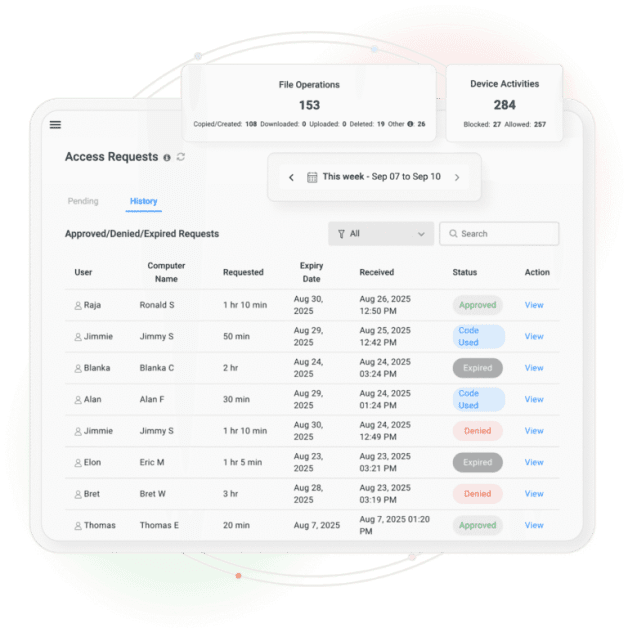
Data Loss Prevention Software That Prevents USB, Cloud, Email and AI Data Leaks
CurrentWare is endpoint DLP software for teams that need control without a lengthy enterprise rollout. Block risky devices, websites, apps, and AI tools, monitor file transfers, and keep audit evidence in one console. Deploy in the cloud or on your own servers.
- Block USB drives, personal cloud storage, webmail, and AI chatbots
- Audit-ready reports for ISO 27001, HIPAA, GDPR, CMMC, and NIST 800-171
- Deploy in under 30 minutes, in the cloud or fully on-premises
*No credit card required · 14-day free trial · For on-prem pricing, contact Sales
700+
Organisations protecting endpoints with CurrentWare
100,000+
Users monitored across 55 countries
4.8/5
Average customer rating on G2 and Capterra
<30 min
From install to your first enforced DLP policy
Data loss prevention software, explained
Data loss prevention (DLP) software monitors, detects, and blocks the unauthorised movement of sensitive data. It controls the channels data can be shared from, like USB drives, personal cloud accounts, webmail, AI chatbots, printers, and network shares.
A good DLP tool protects data in three states:
- Data in use: What someone is actively doing, such as copying a client list to a USB drive, pasting a contract into ChatGPT, printing a patient record, or taking a screenshot.
- Data in motion: Data leaving the organisation through email attachments, web uploads, file transfers, or cloud sync.
- Data at rest: Sensitive files stored on endpoints, file shares, SharePoint, or OneDrive where they should not be.
What Makes CurrentWare Different from Traditional DLP Tools?
Traditional DLP suites often start with lengthy data classification projects. CurrentWare takes a more practical approach: control the channels first. Many real-world data incidents involve simple actions, such as an employee copying files to a USB drive, uploading CAD files to personal cloud storage, or pasting customer records into an AI assistant. Closing these channels can reduce exposure in days, not quarters.
Data loss vs. data leakage vs. data breach: What’s the difference
| Data leakage | Data breach | Data loss |
|---|---|---|
| Sensitive data ends up somewhere it should not, often accidentally. | Confirmed unauthorised access or disclosure, often requiring regulatory reporting. | Includes leaks and breaches, plus data that becomes permanently inaccessible. |
DLP helps stop a leak before it becomes a reportable breach.
Six channels your data actually leaks through, and how CurrentWare closes each one
Most data loss incidents come through a handful of common channels. CurrentWare gives you a specific control for each.
USB drives & removable media
A single USB drive can move an entire customer database outside the organisation without appearing in email logs.
Control: Block, allow, or set devices to read-only by user, group, or device. Allowlist approved encrypted drives by serial number and log every file copied.
Personal cloud storage
Personal Dropbox, Google Drive, and WeTransfer accounts can move large amounts of data outside your control.
Control: Allow approved corporate cloud tenants and block personal ones. Use category and URL filtering to restrict unsanctioned file-sharing sites.
Personal webmail
Employees may forward work files to personal Gmail or Outlook accounts for convenience or during offboarding.
Control: Block personal webmail domains while keeping corporate email available. Get alerts when someone attempts to access them and combine this with file-transfer logs to see what was attached.
AI chatbots & shadow AI
Employees may paste source code, contracts, or patient data into ChatGPT, Claude, Gemini, or Copilot.
Control: Discover which AI tools teams use, then allow or block them by team. Direct employees to approved enterprise AI tools and report on the rest.
Printing & physical copies
Printed case files and patient records can leave the building without the visibility provided by digital DLP tools.
Control: Restrict printer access by user or group and keep activity records so print activity appears alongside USB and web activity.
Network shares & file servers
Over-permissioned network shares can give employees access to data they do not need.
Control: Monitor and restrict network share access, log file activity on mapped drives, and provide evidence of least-privilege controls.
The six types of data loss prevention tools you should know about
DLP covers several types of tools, and most vendors focus on one or two. Knowing what you need helps you choose the right controls.
1. Endpoint DLP
Runs on laptops and desktops to monitor data in use, including copying, pasting, printing, screen capture, and writes to removable media. It works even when devices are off the corporate network. This is where CurrentWare is strongest.
2. Web & cloud DLP
Controls data leaving through browsers, including uploads to personal cloud storage, webmail, file-transfer sites, and generative AI tools. Filtering and URL allowlists or blocklists work on and off the network.
3. Device control
Controls removable media such as USB drives, external HDDs, SD cards, optical drives, Bluetooth, Wi-Fi, and mobile devices. Approved hardware can be allowlisted by serial number.
4. User activity monitoring
Adds context to DLP alerts by showing who accessed what, when, from where, and what happened before the event.
5. Network DLP
Inspects traffic through a gateway or proxy. It can help with on-network email and protocol inspection, but does not cover remote workers on home Wi-Fi or data copied to USB devices. It is typically used alongside endpoint DLP.
6. Email DLP
Scans outbound email for sensitive content and can block, quarantine, or encrypt messages. CurrentWare complements email DLP by controlling webmail and web-upload channels that bypass the mail gateway.
Which one do you need?
If your main risks are departing employees, contractors, USB drives, personal cloud accounts, or AI chatbots, start with endpoint DLP, device control, and web filtering. Add network and email DLP when content inspection of outbound mail is specifically required.
See it running on your own endpoints today
Install the agent on a handful of test machines, block a USB drive, and watch the file-transfer log populate. Most teams have a working DLP policy inside half an hour.
From download to enforced policy in six steps
Get value without a professional services engagement or a lengthy data classification project.
Step 1. Install the agent
Deploy the lightweight client manually, through Group Policy, or with your RMM. Windows, macOS, and Linux are supported. The console runs in the CurrentWare cloud or on your own server.
Step 2. Import users and groups
Sync with Active Directory or Microsoft Entra ID so your existing structure becomes your policy structure. New starters automatically inherit the right controls.
Step 3. Define your policies
Set rules for each group covering devices, websites, apps, and AI tools. Start in monitor-only mode to
understand activity before blocking anything.
Step 4. Monitor activity
The agent records file operations, USB activity, network share access, web and app usage, printing, and cloud uploads, both on and off the corporate network.
Step 5. Enforce policies
When someone attempts a blocked action, such as copying a client list to an unapproved drive or uploading it to personal cloud storage, the action is stopped and logged with the relevant context.
Step 6. Alert, report, and prove it
Get email alerts for high-risk events and scheduled reports for security, compliance, and management. Export logs to Splunk, QRadar, LogRhythm, or Elastic through CEF.
Data loss prevention features without the enterprise overhead
Everything below is included in the CurrentWare Suite. Modules can also be purchased individually.
USB & removable media control
Block, allow, or set read-only access for USB storage, external drives, SD cards, optical media, Bluetooth, Wi-Fi, mobile devices, and more. Allowlist approved encrypted drives by serial number.
File transfer monitoring
Log every file copied, moved, renamed, or deleted on an endpoint or removable device, including the user, machine, timestamp, filename, and destination.
Web & cloud app control
Block unsanctioned cloud storage, personal webmail, file-transfer services, and AI tools by category or URL. Approved corporate tenants remain available, whether employees are in the office or working remotely.
Application blocklisting
Stop unapproved applications such as personal sync clients, remote-access tools, torrent clients, and portable browsers from running.
Insider threat detection
Identify behaviour that may signal data theft, including unusual file-copy activity, after-hours access, access to unrelated folders, or activity around an employee’s resignation.
Role-based access policies
Apply least-privilege controls by department, team, or individual using Active Directory or Entra ID. Different groups can automatically receive different policies.
Real-time alerts
Get email notifications when high-risk events occur, such as blocked USB writes, personal cloud uploads, or restricted share access. Send alerts to security inboxes, ticketing systems, or your SIEM.
Audit-ready reporting
Create scheduled or on-demand reports covering device access, file transfers, blocked attempts, policy changes, and user activity. Export reports to PDF, CSV, or your SIEM.
AI & shadow AI visibility
See which generative AI tools employees use, how often, and which departments use them. Allow approved enterprise AI tools while blocking the rest.
Your newest data loss channel is an AI prompt
In 2026, employees can expose sensitive information simply by pasting customer data, contracts, patient summaries, or source code into a public AI assistant.
Banning AI outright is not a practical solution. Employees may turn to personal devices or accounts, leaving you with less visibility. A better approach is to:
- Discover which AI tools employees use and how heavily
- Direct traffic toward approved enterprise AI tools
- Block consumer AI tools that pose unacceptable risks
- Keep evidence of your AI controls for audits and reviews
CurrentWare provides these controls through the same agent and console used for USB and web protection. No separate AI security product is required.
CurrentWare vs. other employee monitoring and DLP tools
Many tools in this category focus on time tracking and productivity analytics, with DLP added as a secondary feature. If your priority is preventing data from leaving the endpoint, enforcement matters.
| Capability | CurrentWare | ActivTrak | Teramind | Insightful | Hubstaff | Kickidler | Monitask | Time Doctor | Controlio |
|---|---|---|---|---|---|---|---|---|---|
| USB & removable device blocking | Yes | No | Yes | No | No | No | No | No | Limited |
| Device allowlist by serial number | Yes | No | Yes | No | No | No | No | No | No |
| File transfer logging to removable media | Yes | No | Yes | Limited | No | Limited | No | No | Limited |
| Web filtering & URL blocking | Yes | Limited | Yes | Limited | Limited | Limited | Limited | Limited | Limited |
| Application blocklisting | Yes | No | Yes | No | No | Limited | No | No | Limited |
| Printer access control | Yes | No | Yes | No | No | No | No | No | No |
| Fully on-premises / self-hosted option | Yes | No | Yes | Limited | No | Yes | No | No | Yes |
| Modular pricing (buy only what you need) | Yes | No | Limited | No | Limited | No | No | Limited | No |
| Free trial without a sales call | Yes | No | Yes | Yes | Yes | Yes | Yes | Yes | Yes |
| Primary product focus | DLP & endpoint control | Productivity analytics | DLP & UAM | Time & productivity | Time tracking & payroll | Screen recording | Time tracking | Time & productivity | Screen recording & UAM |
| Why teams switch to CurrentWare Productivity tools may tell you that a file was copied. CurrentWare can stop the copy from happening. For compliance, IP protection, and insider risk, enforcement matters more than reporting alone. | Why regulated buyers choose on-premises Organisations such as police forces, defence suppliers, NHS trusts, and government agencies may not be able to send activity data to a vendor cloud. CurrentWare can run entirely within your network, on your own servers, without an outbound dependency. | Read the full comparisons See detailed feature-by-feature comparisons with individual vendors, including screenshots and pricing notes. Browse all comparisons → |
|---|
Cloud or on-premises. Your data, your choice.
CurrentWare gives organisations a choice of deployment based on their security, compliance, and infrastructure requirements.
CurrentWare Cloud
Best for distributed and hybrid teams, MSPs, and organisations without a dedicated server team.
- No infrastructure: Nothing to host, patch, or back up
- Works off-network: Policies follow laptops to home Wi-Fi, hotels, and client sites
- Automatic updates: New releases and threat categories arrive without maintenance windows
- Scales with headcount: Add or remove seats as teams change
- Self-serve trial: Get started without a sales call
- Data residency: Confirm the available hosting region for your country with Sales
CurrentWare On-Premises
Keep the platform and activity data within your own infrastructure for environments with strict data residency or security requirements.
Removable Media Policy Template
Auditors do not accept “we block USB drives” as a control. They want the written policy behind it. This editable template gives you the document, ready to adapt to your organisation.
- Approved device categories and the exception process
- Encryption, handling and disposal requirements
- Roles, responsibilities and acceptance wording for staff
- Maps to ISO 27001, Cyber Essentials and NIST 800-171 controls
What each team gets from data loss prevention software
IT & Security
Control removable media, restrict network shares, enforce acceptable-use policies, and investigate incidents with a complete activity timeline.
Compliance & Risk
Maintain audit-ready logs and provide evidence of technical controls for ISO 27001, HIPAA, GDPR, PCI DSS, CMMC, and NIST 800-171.
HR & People Operations
Use proportionate, event-level records for investigations and offboarding without relying on keystroke surveillance.
Operations & Remote Teams
Apply the same controls to home, hybrid, and field workers as you do in the office. Policies follow the device wherever it works.
Data loss prevention by industry
Healthcare
Protect PHI and support HIPAA safeguards with device control and access logging.
Government & Public Sector
Protect CUI and FCI with controls aligned to NIST 800-171 and CMMC, including on-premises deployment.
Legal Services
Prevent unauthorised copying of case files and privileged client information.
Manufacturing
Protect CAD files, tooling data, and trade secrets from IP theft.
Financial Services
Control access to cardholder and client data with audit trails.
Schools & Libraries
Use CIPA-compliant filtering to support E-Rate requirements and safer internet access.
Small Business
Get enterprise-grade controls without the cost or complexity of a large security team.
Managed Service Providers
Deploy and manage DLP across multiple client tenants from one place.
Built to Support Your Compliance Program
Discover how organizations use CurrentWare to improve visibility, strengthen compliance efforts, and manage employee activity more effectively.
Leading teams already use CurrentWare to prevent their data end-points
Pick & Plug Into Your Existing Stack
CurrentWare works alongside the identity, security, and directory tools you already use, including support for SAML, OIDC, and CEF standards. Cloud connectors are on the way.
- Tested & supported
- Generic standards (SAML, OIDC, CEF)
- On the roadmap (Cloud)
Get answers to common questions about CurrentWare’s DLP solution
Frequently Asked Questions
-
CurrentWare’s DLP solution, powered by AccessPatrol, prevents data theft by blocking unauthorized USB devices, cloud apps, and file transfers. It gives IT teams visibility and control over sensitive data movement across endpoints.
-
CurrentWare combines device control, web filtering, and user activity monitoring to stop both malicious and accidental leaks. IT admins can block USB drives, restrict risky cloud apps, monitor file transfers, and get real-time alerts when suspicious activity occurs.
-
Unlike complex enterprise DLP platforms, CurrentWare is lightweight, affordable, and easy to deploy. With pricing starting at just $5/user/month, organizations get enterprise-grade security without the heavy overhead.
-
Yes. With BrowseControl web filtering and AccessPatrol’s file transfer controls, CurrentWare blocks uploads/downloads to unmanaged cloud apps like Google Drive or Dropbox, ensuring data stays in approved channels.
-
Absolutely. CurrentWare policies apply to remote endpoints as well, ensuring that employees working offsite remain protected against data leaks, whether they’re on or off the corporate network.
-
CurrentWare helps organizations comply with ISO 27001, HIPAA, GDPR, PCI-DSS, NIST 800-171, and other frameworks by controlling removable media, monitoring data flows, and generating audit-ready reports.
-
CurrentWare installs in minutes and is centrally managed through a web console. IT admins can apply policies by user, group, or device, integrate with Active Directory, and manage thousands of endpoints at scale.
-
CurrentWare starts at just $6 USD per user/month (billed annually). You can test-drive the full solution with a 14-day free trial or book a demo with our experts.
-
Yes. The CurrentWare Suite combines AccessPatrol (USB blocking & DLP), BrowseControl (web filtering), and BrowseReporter (employee monitoring) to deliver a complete insider threat protection platform.
Get Started With Your Free Trial
Stop USB Data Leaks. Prove Compliance. Stay Audit-Ready
No Credit Card Required
All subscriptions include ongoing updates and direct support from our team.