

Want to use this infographic on your website or blog? Feel free, just provide a link back to our website when citing your sources.
Also Read: Remote Employee Monitoring Software—Track WFH Teams
Go From Statistics to Strategy
Get the specific productivity data for your team to improve focus and ensure accountability
Remote Work Engagement & Productivity Infographic Transcript
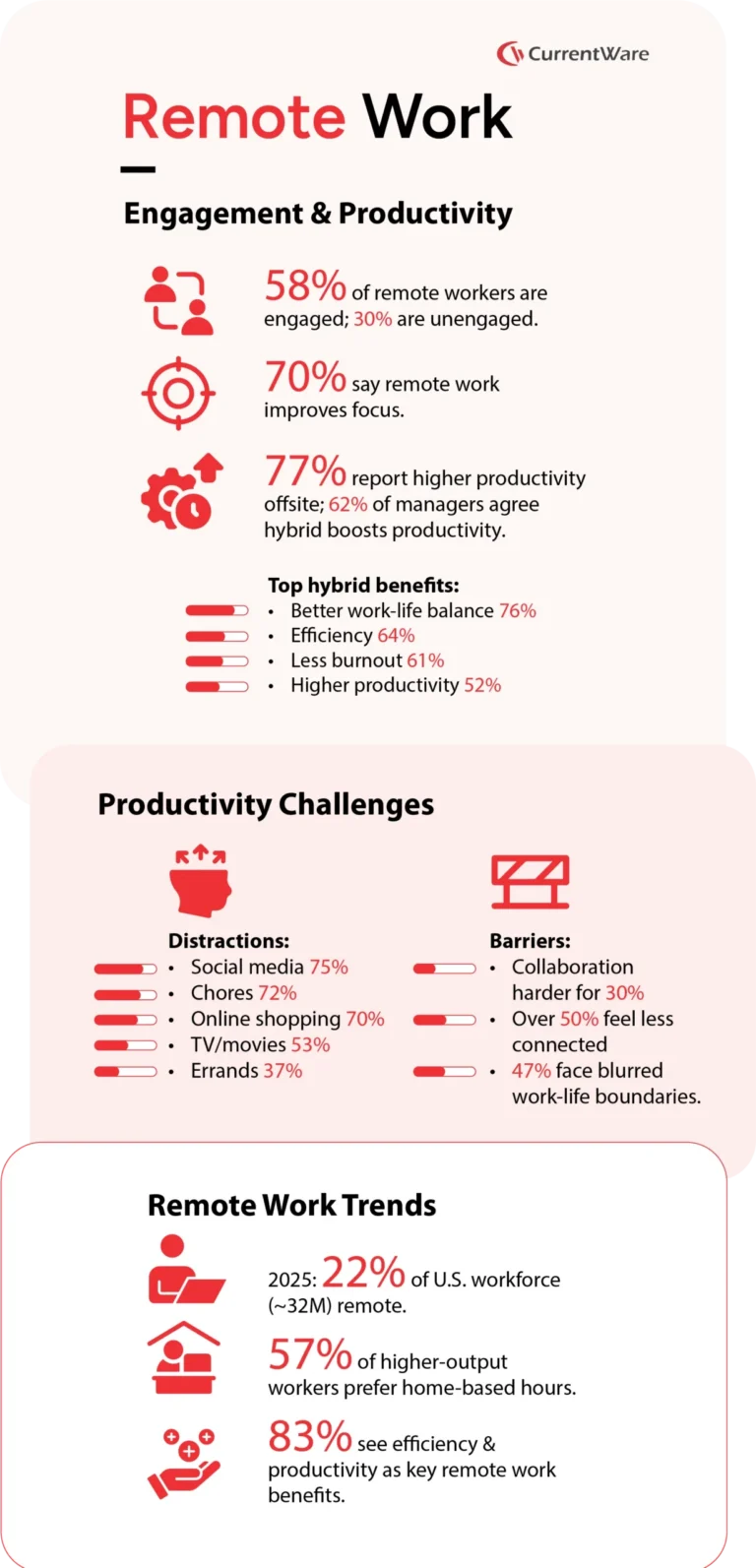
58% of remote workers are very or somewhat engaged with their job, while 30% are somewhat or very unengaged.
- 70% say remote work helps them focus better.
- 62% of managers feel their teams are more productive in a hybrid work arrangement.
- 77% of remote workers say they are more productive offsite.
Of those who work remotely at least a few times per month, 77% reported greater productivity while working offsite; 30% said they accomplished more in less time and 24% said they accomplished more in the same amount of time.
Hybrid Work Benefits
- Better work-life balance (76%)
- More efficient work (64%)
- Less burnout (61%)
- Higher productivity (52%)
Challenges to Remote Productivity
Distractions common among remote workers include:
- Social media scrolling (74.7%)
- Household chores (71.6%)
- Online shopping (69.9%)
- Watching TV/movies (52.9%)
- Running errands (37.4%)
Collaboration and communication barriers:
- 30% find collaboration more difficult remotely.
- Over 50% of fully remote workers cite limited connection with colleagues as a top concern.
- Blurred work-life boundaries are a challenge for 47%, with 34% feeling pressured to always be available.
Remote Work Trends & Workforce Impact
- Remote work is recognized as a strategic advantage, contributing to better work-life balance, reduced stress, and higher productivity.
- In 2025, 22% of the U.S. workforce (over 32 million workers) work remotely.
- Of all employees who reported doing more work per hour, 57% preferred working most or all their hours at home.
- 83% of employees cite the ability to work more efficiently and productively as a primary benefit of working remotely.
Sources
- Buffer. (2023). State of Remote Work Survey. Retrieved from buffer.com/state-of-remote-work/2023
- ConnectSolutions. Study on Teleworker Productivity. Society for Human Resource Management. https://www.shrm.org/topics-tools/news/technology/study-teleworkers-productive-even-sick
- Gallup. (2025). Indicator: Hybrid Work and Employee Productivity. https://www.gallup.com/401384/indicator-hybrid-work.aspx#ite-510890
- Owl Labs. (2022). State of Remote Work Report. owllabs.com/state-of-remote-work/2022
- U.S. Career Institute. (2024). Eye-Opening Remote Work Statistics. uscareerinstitute.edu/blog/remote-work-statistics-2024
- StrongDM. (2025). 11 Surprising Statistics on Remote Work. strongdm.com/blog/remote-work-statistics
- Apollo Technical. (2025). Surprising Working From Home Productivity Statistics. apollotechnical.com/statistics-on-remote-workers
- Great Place to Work. (2025). Remote Work Productivity Study: Findings from a 4-Year Study. https://www.greatplacetowork.com/resources/blog/remote-work-productivity-study-finds-surprising-reality-2-year-study
- Neat. (2025). The State of Remote Work 2025 Statistics. https://neat.no/resources/the-state-of-remote-work-2025-statistics/
- Crossover. (2025). Remote Work Productivity Statistics. https://www.crossover.com/resources/remote-work-productivity-statistics-2025-that-prove-ceo-s-wrong
- Becker Friedman Institute, University of Chicago. (2025). Remote Work, Employee Mix, and Performance. bfi.uchicago.edu/wp-content/uploads/2025/05/BFI_WP_2025-68.pdf


