
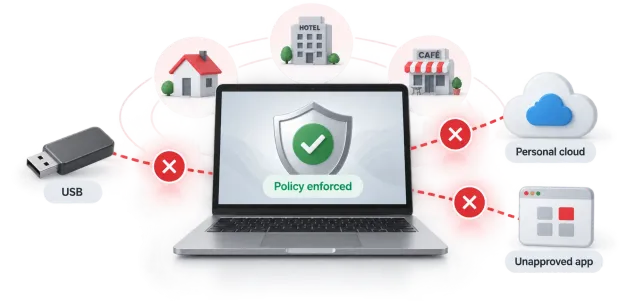

Just providing employees with laptops and VPNs will not be sufficient for protecting a distributed workforce in 2026; IT managers will also have to put in place a framework, that is, a written agreement which outlines network access, the rules concerning data loss prevention (DLP), and the way in which employees are to be monitored so as to take into account both security issues and the legal nuances of current state privacy laws. The guide explains what a modern acceptable use policy (AUP) should include, the laws that make it necessary, and how to enforce it after it has been signed using technical controls.
To conclude, the four key components of a 2026 AUP compliance structure are transparency about monitoring, rules on the use of the internet and the web, endpoint DLP controls, and device security standards, and in cases where legal requirements apply, written notice together with employee acknowledgement is needed.
What are the main pillars of an acceptable use policy nowadays?
The Acceptable Use Policy sets out what corporate technology, data, and network resources employees are allowed and not allowed to use; in a remote working situation it should also include details on how endpoints should be secured when working from home, the approach to shadow IT, limitations on the use of personal devices, and clarity regarding monitoring. Enforcing the AUP helps to reduce compliance liability, safeguards intellectual property, and addresses expectations before any disputes occur.
It must also be a two-way arrangement, not merely a set of restrictions. Employees ought to know precisely what is being monitored and the reasons for it, as indistinct monitoring statements are a major source of disputes and can lead to legal problems under written-notice laws in different states.
A clearly defined acceptable use policy sets out the boundary between corporate surveillance and personal privacy, in particular by specifying what is monitored on the company’s work laptop during work hours and what is seen on the employee’s own device or outside of their working time, so that warnings are given as early as possible on either side of that line before any issues occur, rather than only after the fact.
Why is a written policy legally required for employee monitoring in 2026?
Because workplace privacy has changed, written consent is now absolutely necessary. In a number of states, employers must give employees written notice, and in some cases they must also get their acknowledgement before monitoring employees’ activities on company systems. Failing to do so is a common basis for a workplace privacy claim. The following laws apply:
| State | Statute | Core requirement |
|---|---|---|
| New York | Civil Rights Law § 52-c | Written notice of electronic monitoring, posted or provided to each employee |
| Connecticut | C.G.S. § 31-48d | Prior written notice of monitoring type and method |
| Delaware | Del. Code Title 19 § 705 | Written notice, acknowledged before monitoring begins |
| California | CCPA/CPRA | Extends data privacy rights to employee HR and monitoring data |
What are the security risks of an unmanaged remote workforce?
In the lack of controlled endpoints and clear rules, organizations would be very vulnerable, and industry research shows just how great these risks are.
- The figure stating that 70% of cases of intellectual property theft occur within 90 days of an employee informing their company that they are leaving (Infosecurity Magazine) is frequently referred to in insider-threat research and is included in CurrentWare’s own offboarding guidelines.
- There are vulnerabilities associated with Shadow IT since employees often take company data and store it on cloud platforms that are outside the control of IT. 80% of IT professionals state that employees store company data on cloud platforms that have not been sanctioned.
- In companies that have no policy in place for web filtering, 58% of employees spend at least four hours a week (that is, 26 workdays each year) on non-work websites (according to the 2018 Spiceworks survey) – a figure based on older data but still the one most commonly used as an indicator of unmanaged productivity.
- Compliance fines: The Flexera State of ITAM Report states that nearly half of organizations ended up paying over $1 million in vendor software audits during a three-year period.
What are the primary pillars of an acceptable use policy at present?
To effectively bridge policy intent and technical execution, a 2026 AUP must include four foundational pillars:
Four pillars, each mapped to a control:
| Pillar | What it governs | Typical enforcement |
|---|---|---|
| Monitoring transparency | What's tracked (app usage, active time) vs. what isn't (keystrokes, personal messages) | Written notice + visible monitoring indicator |
| Internet use & web filtering | Bandwidth limits, prohibited categories | Web filtering software |
| Endpoint security & DLP | USB and personal-cloud restrictions | Read-only USB policy, upload blocking |
| Device management | Encryption, session timeouts, patch cadence | AES-256 disk encryption, MFA, automated patching |
How do compliance models dictate technology policy requirements?
Major regulatory systems require companies to draw up policies which are documented, approved, and technically enforced. The main areas in which compliance is aligned are:
- In order to comply with CMMC Phase 2 and NIST 800-171, companies are required to put in place formal controls relating to media exfiltration, device access, and audit logging in order to protect Controlled Unclassified Information (CUI).
- The ISO 27001 standard specifies that an approved policy must be accompanied by verifiable technical controls, as set out in Annex A in the sections dealing with access control, cryptography, and operations security; these measures are directly related to endpoint enforcement and DLP.
- The forthcoming 2025 update to the HIPAA Security Rule would require more stringent access controls and device management for endpoints that handle PHI; however, since it has not yet been finalized, it should be referred to as forthcoming, not as existing legislation.
What elements should a standard Acceptable Use Policy template include?
The template should be simple for the HR and IT departments to adapt and include the usual sections.
- The policy’s purpose and scope must clearly indicate which employees it applies to, specifically, full-time remote workers, hybrid workers, and on-site employees who use company equipment while working away from the office. Expressing the scope in terms of ranges creates loopholes in enforcement. By clarifying these categories at the start, it will be possible to determine who is and is not covered by the policy and when.
- To ensure device security, require whole-disk encryption (using AES-256) on every endpoint that interacts with data, require multi-factor authentication for all corporate accounts, and implement high-level physical security measures, such as locked screens, no device sharing, and safe laptop transport. These measures are fundamental security controls that auditors expect to see documented, not merely as optional recommendations.
- The web restrictions prevent access to illegal content, websites that carry malware, and high-bandwidth media not approved for use on company computers or networks. These restrictions are not enforced by a person since web filtering software automatically applies them to all managed endpoints, no matter where they are located, without employees having to monitor them.
- The rules set out by the DLP mean that it is necessary to prohibit the use of unauthorized USB drives and uploads to personal cloud accounts (for example, Dropbox or personal Google Drive) when company equipment is being used; this prevents the two most frequently used methods of data exfiltration, namely the use of physical media and unmanaged cloud syncing, thus ensuring that data does not leave the organization without IT knowing about it or there being a record of the event.
- Regarding electronic monitoring, be specific as to what is being monitored. State the kinds of data that are being collected, the amount of time spent on an application, the amount of time spent on a website, and website categories versus keystrokes or personal messages. Before monitoring begins, get signed consent; in some states, consent must be in writing, not just as a policy statement but as a legal requirement.
How can IT leaders enforce written policies technically?
An acceptable use policy in writing is not enough since it also has to be automatically and technically enforced; IT teams usually make use of a unified endpoint management (UEM) suite such as CurrentWare in order to automatically convert the written rules into active measures on the network. This deployment includes:
- By integrating with Active Directory, policy rules can be linked to existing AD organizational units so restrictions are automatically enforced by role, department, or location, using tools such as CurrentWare’s GPO-based deployment method. Manual configuration isn’t needed for each device, since new employees automatically receive the proper restrictions as soon as their account is placed in the correct organizational unit.
- With Web and App Filtering, you can block traffic for cloud applications such as video streaming, stop file sharing, prevent data leaks, and restrict access to unwanted or malicious websites, using tools like BrowseControl. These settings apply at all times to all managed devices, regardless of location, whether the device is used by a remote employee connected from home or by someone on-site.
- Peripheral Protection has the option of making the USB ports ‘read-only’ or of completely blocking all unauthorized removable media devices using a DLP solution such as Access Patrol; thus eliminating the physical means by which data could be leaked that software-only solutions fail to address and ensuring that important files do not leave a private drive even without IT involvement.
- In order to carry out an audit, it is necessary to store the automated reports which prove that the policy had been enforced and to maintain records of the use of the monitoring software license up to the time of the audit; thus, rather than having to urgently demonstrate during the audit that the policies had always been in place, IT can produce a continuous documented record to show this.
Is it ethical and lawful to use a worker tracking system?
It is legal across the entire United States to maintain records of company assets such as the devices that the company owns, on the grounds of the “ordinary course of business” exemption to the Electronic Communications Privacy Act; in 2026 the real question is not whether the policy is legal but whether it is transparent, the policy being justifiable and trust being maintained when you make your employees aware that you have effective monitoring, but carry out this monitoring in a ‘transparent manner’ instead of a hidden one and without making use of keystroke logging or webcam capture.
As IT Manager at EHOB, SA’RAH PLESNER, says: “We wanted a product that was easy to use, had a good price, and was strong enough to provide the information we needed without including invasive features such as keystroke tracking. We don’t want to be like Mr.Smith from the Matrix when monitoring our people!”
By choosing transparency over surveillance, organizations not only foster a culture of trust but also ensure the safety of their remote workers and meet the required regulatory standards.
Conclusion
A 2026-compliant acceptable use policy is only effective when the written policy and technical enforcement align. Nail the core paragraphs – Scope, Device Security, DLP Enforcement, Monitoring Transparency- and defend it with automated technical controls like AD-mapped GPOs, Web filtration, and USB-only systems, and you’ll find that the policy survives both the compliance audit and the law review. Fail to do either, and you end up with a set of restrictions nobody ever follows. The ultimate aim isn’t surveillance but supporting a decentralised workforce that isn’t living in fear of what’s being watched.


