
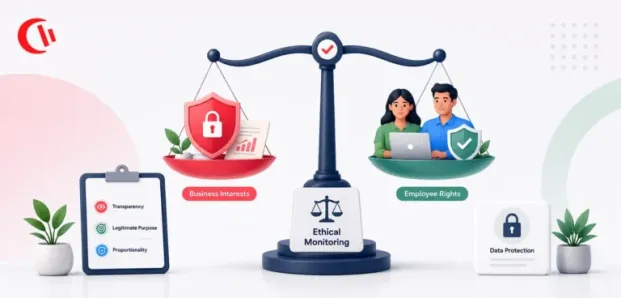

Consider a corporate scenario where an employer tracks every click, email, keystroke, and even minute spent off-screen. Employee monitoring is often framed as a positive workplace practice to safeguard crucial information, increase productivity, and manage remote teams. However, extensive employee tracking can quickly make employees feel watched rather than trusted.
That is where the core debate of whether employee monitoring ethics should exist in a modern workplace, what the relevant best practices are, and how real-world scenarios make it more explicable is elaborated further. Ethical employee monitoring strikes a delicate balance between a company’s justifiable business interests and an employee’s right to privacy, dignity, autonomy, and trust.
Key Takeaways:
- Employee monitoring should always follow an ethical approach that primarily serves business goals while also protecting employee privacy.
- Ethical employee monitoring should have a real purpose of identifying data breaches, fraudulent activities, and lack of productivity.
- Ethical employee monitoring should focus on the target information rather than excessive tracking.
- The employees under the purview should be aware that their data is being monitored. Transparency should be maintained in sync with employee policies.
- CurrentWare provides legal monitoring with adjustable viewing times, data limits, privacy filters, security settings, data retention periods, self-monitoring capabilities, and organizational control over logged data.
What is Ethical Employee Monitoring?
This is responsible and reasonable use of monitoring technology to track employee output, protect corporate assets, boost performance, and support staff welfare and productivity, while still respecting employee privacy as much as possible.
The guiding principles for ethically monitored employees are respect, balance, proportionality, fairness, transparency and employee consent. Employees must be informed of what is recorded, why it is recorded, where the data will be stored and who will access it. Employee monitoring ethics works well when applied responsibly and transparently, balancing security and performance outcomes against employee rights and dignity, and fostering trust within the workplace.
Is Employee Monitoring Legal?
Yes, it can be legal to monitor your employees, depending on the applicable privacy and employment laws in the country, as well as the nature of the monitoring and how data is managed. Employers have legitimate concerns, including preventing data breaches and security incidents, maintaining workplace productivity, and investigating employees accused of misconduct. It is important to note that monitoring should not grant an employer limitless insight into their employees’ activities.
Employee monitoring is permitted from an ethics perspective if it is necessary, proportionate, transparent, and not unduly intrusive of your privacy. You should be notified of monitoring activities through clear workplace policies, especially when monitoring extends to your private data, personal communications, geographic location, and/or activities occurring outside normal working hours.
Key Principles of Ethical Employee Monitoring
The following key principles can form the basis for an organization to create an accountable employee monitoring system:
1. Transparency
Employees need to be aware of the rationale for data monitoring, the types of data extracted, and the point of contact within the company who has access to the monitored data.
2. Legitimate Purpose
Businesses need a genuine business purpose (e.g., security, legal compliance, operational needs) rather than invasive employee monitoring.
3. Proportionality
The monitoring method should be proportional to the goal you are trying to achieve and not unduly intrude on workers.
4. Privacy Preservation
Protect workers’ privacy, especially regarding personal information, actions outside the workplace, or activities during non-work hours on personal devices.
5. Data Minimization
Be specific about the data collection necessary to address your particular issue or goal.
6. Consistency
Companies should not have different monitoring standards for different groups of workers, and monitoring should be enforced consistently.
7. Limited Access
Access to information collected from monitoring should be granted to the necessary and authorized personnel.
8. Clear Retention
The length of time that data is retained and eventually securely deleted should also be clearly communicated.
Why Do Employers Monitor Employees? The Legitimate Case
In many industries, companies monitor employees to ensure compliance with operational, security, or regulatory requirements. With the shift toward greater reliance on digitally integrated businesses, cloud environments, and sensitive data, a degree of monitoring is necessary to help companies protect their business and employees from emerging threats.
The legitimate reasons for employee monitoring may include:
- Cybersecurity: Identifying suspicious activity, unauthorized access to systems, malicious software, or possible security risks.
- Data Protection: Protecting sensitive company, customer, and financial data from unauthorized access, misuse, or dissemination.
- Compliance: Ensuring businesses adhere to relevant legal or contractual regulations, as well as those mandated in a particular sector.
- Productivity: Gaining insights into workflow processes to identify the level of team productivity.
- Workplace Safety: Certain work environments can be monitored to spot potential safety hazards for workers.
- Remote Team Tracking: Employee tracking provides visibility in remote-working scenarios. Working hours, screen time, task completion, and overall activity are thoroughly tracked to support goal accomplishment.
- Fraud Prevention: Detect possible malicious activity that could cause economic damage in the company.
Best Practices for Monitoring Employees Ethically
Employees are monitored to improve productivity, efficiency, and security, and to help address workflow issues. When introducing this technology, the ethical aspects must be taken into account:
- Set a purpose
An organization should have a clear purpose for implementing ethical employee monitoring. - Inform employees
Communicate the significance of ethical employee monitoring to the team. Provide details on the areas to be monitored and the ways data will be used. - Monitor only work activities
Focus on information relevant to business operations rather than employees’ personal activities. - Create a monitoring policy
Documenting monitoring terms is an ideal practice to ensure employee rights and data are protected, even when tracked for work purposes. - Secure collected data
Ensure employee data is protected from unauthorized access. - Avoid relying solely on monitoring metrics
Employee monitoring data should not be the sole yardstick for measuring individual employee performance. - Provide a feedback mechanism
Give employees the freedom and flexibility to voice their concerns related to monitoring practices and privacy. - Build trust through transparency
Employees should be positively conditioned regarding ethical employee monitoring practices. Communicate the benefits and limitations clearly, rather than portraying it as a hidden tracking activity.
When Employee Monitoring Goes Too Far: Real-World Examples
Organizations support employee monitoring to track workforce activities, team performance, and to identify any discrepancies or threats. However, it is alarming when ethics fade, and excessive monitoring invades employee privacy. There are always repercussions when boundaries are crossed beyond ethical employee monitoring.
These are practical industry examples of when excessive monitoring went too far:
- Amazon France Logistique: €32 Million Fine
In January of 2020, France’s data protection regulator fined Amazon France Logistique 32 million euros for monitoring how it tracks worker productivity through its barcode scanners. This unethical employee monitoring aggregated average transaction data across all warehouses and caused issues that eroded worker trust. - H&M: €35.3 Million Fine
In 2020, German authorities fined H&M £31.3m after identifying and investigating widespread employee monitoring of staff at its service center in Nuremberg. Managers had systematically gathered data about staff and their family circumstances, family life and holidays. The data was shared between managers and used to influence employment and disciplinary actions against staff. Regulators considered the scale of the data collection a serious privacy violation.This case showed that invasive employee monitoring does not always extend to computer activity and CCTV surveillance; monitoring employees’ private information to such a vast degree also counts as surveillance. The scandal is a cautionary warning about respecting privacy and the right not to have personal information collected.
Employee Monitoring vs. Surveillance: What Is the Difference?
Employee monitoring and workplace surveillance can overlap but can have very different outcomes. Employee monitoring involves the monitoring of limited, focused work data within an organization to increase productivity, security, or meet operational and compliance requirements.
Workplace surveillance, on the contrary, is pervasive over employees to a great extent, without transparency. Employee monitoring is appropriate if there is a legitimate purpose and it is limited in scale, and over-monitoring will threaten employees’ privacy, autonomy, and trust.
| Employee Monitoring | Workplace Surveillance |
|---|---|
| Operates with a defined business purpose | May involve broad or continuous observation |
| Focuses on relevant work activities | Can extend into private activities |
| Employees are informed about the practice | May be conducted with limited transparency |
| Collects necessary information | Can involve excessive data collection |
| Respects reasonable privacy boundaries | Can create a feeling of constant observation |
| Supports security, productivity, or compliance | May primarily emphasize control and oversight |
How CurrentWare Supports Ethical, Transparent Monitoring
Ethical employee monitoring goes beyond gathering work-related data; it is about providing the organization with useful insights while respecting employees’ privacy within limits.
CurrentWare offers flexible monitoring and privacy controls to help businesses adopt a more proportionate approach to employee monitoring, with limits on information collection, monitoring hours, retention, and user access.
Ways CurrentWare can support Employee monitoring Ethics include:
- Visibility: Organizations can make the workforce aware of monitoring and provide specifics on the monitored aspects in accordance with workplace policies.
- Set Monitoring Hours: Conduct employee monitoring activity at designated work hours.
- Data Limitation: The employee tracking options can be customized specifically to collect relevant information.
- Privacy Exclusions: CurrentWare employee monitoring does not include keylogging or audio or video recording features. Screenshot capabilities are optional and configurable.
- Access Availability: Permissions to view monitored data can be flexibly limited to designated managers and administrators.
- Information Retention: Administrators can specify retention periods and use deletion policy controls to remove unnecessary monitoring data.
- Employee Access: CurrentWare provides end-user reporting solutions so staff can self-analyze their monitored data.
- Data Storage: The on-premises deployment facility retains the tracked employee data within the organizational control.
Disclaimer: This information is provided for reference only; it does not constitute legal advice. Reach out to local experts who are well versed in the legalities surrounding employee rights before you begin to implement your employee monitoring at your workplace.
Conclusion
Employee monitoring can lead to tangible results, increasing cybersecurity, business efficiency, and overall business data safety. However, the effectiveness of the solution still varies on the conscious usage of this practice. When it comes to employee monitoring ethics, transparency, proportionality, minimization, privacy, data security, and accountability should always govern any monitoring practice. Businesses need to: monitor only what is necessary; be transparent about what is collected; prevent unauthorized individuals from accessing monitored data; and re-evaluate the feasibility of monitoring.
CurrentWare empowers employers with privacy-focused capabilities. Employers can ensure employees are aware of monitoring, limit the data they collect, prevent employees from being monitored at all times, schedule when to monitor, keep only certain data for specific durations, use permissions to restrict access to monitoring, and grant employees the ability to access all of their own user-level data.
With the power of monitoring, coupled with appropriate policies, good governance practices, and employee privacy protections, your organization can achieve workplace transparency and security without violating your employees’ trust.
Frequently asked
Frequently Asked Questions:
-
Yes, the practice of employee monitoring is ethical when conducted in accordance with applicable laws and policies. Primarily, employee monitoring should serve corporate purposes such as data security, productivity, and team performance assessment. Ethical employee monitoring retains employee privacy and builds trust within the organization.
-
The critical issues that arise during employee monitoring are:
- Invasion of employee privacy
- Irrelevant areas of data tracking
- Excessive hours applied to monitoring
- Unauthorized data access
- Absence of data retention policies
-
Yes, ethical and responsible employee monitoring will always have the employees informed about the necessity of monitoring procedures. Employees should be given sufficient clarity on the collection, use, and accessibility of monitored data. Ethical monitoring should always adhere to the principles of transparency, proportionality, and respect for employee privacy.
-
In some cases, employers may seek consent to monitor employees’ personal devices. This activity should entirely adhere to the organizational goals and employee policies. It is essential that organizations have clearly defined employee monitoring policies, avoid excessive data collection, and refrain from accessing personal information when employees are off the clock.
-
Yes, employers managing remote teams across different locations can request to monitor the work activities. This is mainly to assess employees’ dedicated work hours, task focus, availability, and daily productivity. This monitoring must be proportional and only related to the work being done.
-
No, it is not ethical to monitor employees off the clock, as this decreases the relevance to the actual job. Besides, it can be an invasion of workers’ privacy beyond working hours. Ethical monitoring is always in effect during operational hours and only for work-related purposes.
-
Employee monitoring is usually confined, specific, and related to work purposes like productivity, cybersecurity, legal compliance, or data privacy. Workplace surveillance is widespread and can be excessive or constant, extending into private employees’ matters. The core is purpose, scope, transparency, and proportionality.
-
An employer can monitor your work communications (emails and messages) if there is a business reason and workplace policy in place. But accessing or monitoring personal communications may raise privacy and ethical considerations. If employers monitor your communications, it should be explained through policy or otherwise.
-
An employer might look into your public social media activity; if there is a valid workplace reason, it should refrain from reviewing private messages, private accounts, or activity occurring outside work, since it’s a serious privacy and ethical issue. The best practice is to avoid overstepping boundaries and to have a clear social media policy in the workplace. Ethical employee monitoring protects employees from unwarranted interference. It should not extend workplace monitoring into employees’ private lives, as this can infringe on employee autonomy and personal privacy.
-
Employers should never monitor employees for irrelevant or intrusive information that is not for a good workplace purpose. This can include what staff are doing in their own time, their personal correspondence, excessive location data, and sensitive information unrelated to the reason for monitoring.
-
An ethical employee monitoring policy should clearly state what is monitored, why monitoring is necessary, what data is collected, who can access it, how it is protected, and how long it is retained. For the U.S. market, employers should also account for federal requirements and applicable state privacy and electronic-monitoring laws, which can vary by jurisdiction. CurrentWare recommends transparency, clearly defined monitoring purposes, privacy expectations, data security measures, and limited access to employee data. Download the Free CurrentWare Workplace Monitoring Policy Template.
-
Yes, the General Data Protection Regulation (GDPR) does permit employee monitoring, but employers must ensure the monitoring is legitimate, fair, transparent, necessary, and proportionate. Employers do need to have legal grounds for processing employees’ data, and monitoring must have a clear objective purpose and not be conducted “just in case”.
-
Penalties for unlawful employee monitoring can include substantial fines, regulatory action, reputational damage, and employee claims. Under the GDPR, serious violations can attract fines of up to €20 million or 4% of an organization’s worldwide annual turnover, whichever is higher. For example, France’s data-protection authority fined H&M €35 million in 2020 over unlawful employee surveillance, while French regulators fined IKEA France €1 million in 2021 for improperly collecting and using employee information. These cases show why employers should make workplace monitoring necessary, proportionate, transparent, and legally compliant.
-
CurrentWare encourages responsible employee monitoring through its focus on transparency, privacy, and data minimization. Its systems offer capabilities that can alert employees to monitoring, restrict usage to work hours only, define the types of information tracked, control access using role-based permissions, and institute data retention. CurrentWare does not capture sensitive employee information such as keystrokes, audio or video, or the content of instant message conversations, enabling companies to observe work activity for security and performance purposes only.