In 2026, as hybrid and remote work continue to affect the modern workplace, small and mid-sized businesses (SMBs) are once again considering how to manage and keep track of their dispersed workforces. The Gallup 2026 Hybrid Work Indicator shows that 78% of U.S. employees in jobs that allow them to work from home either work in a hybrid arrangement (52%) or are entirely remote (26%), with flexible work having become the main working model for roles in the knowledge sector.
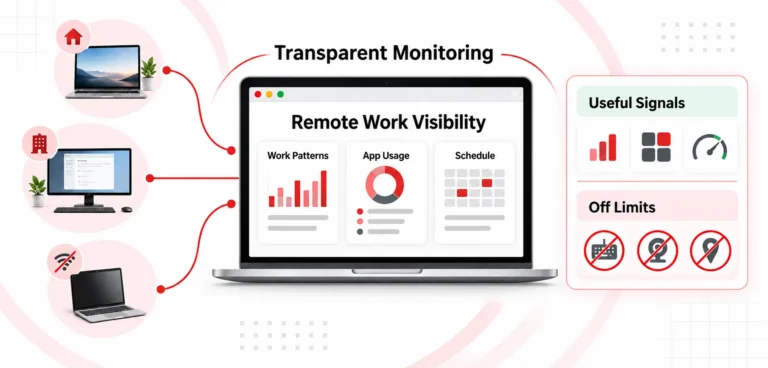
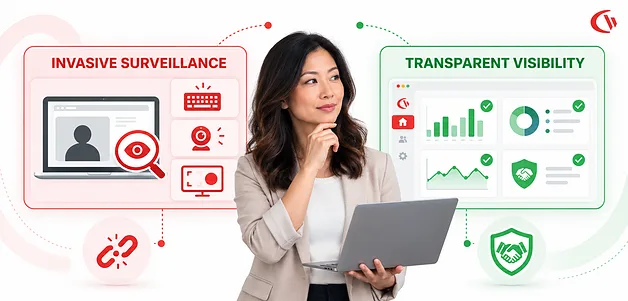
At the same time, the employee surveillance market is at a pivotal point, since companies have to choose between using transparent endpoint user activity monitoring software that enables them to see what applications are being used, what websites are accessed, employees’ working patterns, and security events, and more intrusive computer surveillance software, a form which employees at times call ‘bossware’ or ‘tattleware’.
It is a major difference because tools that continuously capture every keystroke, log all desktop activity, have access to webcams and microphones, or employ optical character recognition (OCR) to scan screen content raise serious concerns about data privacy, security, compliance, and employees’ rights. For small and medium-sized businesses (SMBs), excessive monitoring can erode staff trust and introduce additional security and functional risks.
A more sensible method would be to openly monitor employees’ activities. Nowadays, workforce analytics deliver useful knowledge of productivity, application usage, security risks, and endpoint behaviour, enabling small and medium-sized enterprises to better monitor their remote workers and improve their cybersecurity visibility without turning workplace monitoring into excessive surveillance.
What is Transparent Workplace Tracking Software vs. Invasive Spyware
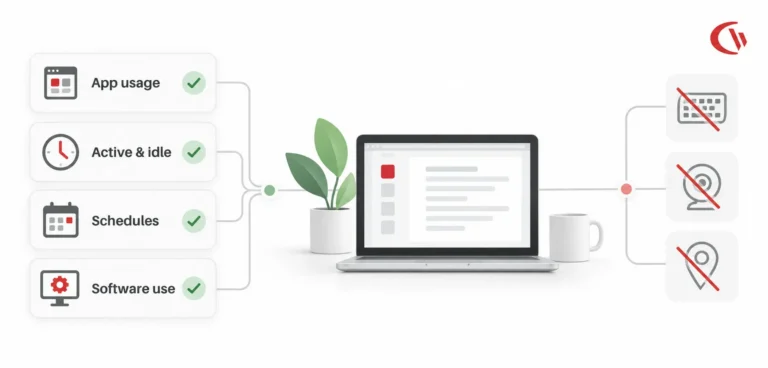
Transparent workplace tracking software provides benefits for monitoring system activity, helping ensure the security of websites and applications, and maintaining compliance with company policy. Unlike intrusive monitoring, it does not focus on individuals’ actions but instead examines aggregated data, such as system and application usage, the types of websites accessed, USB usage, and logon times. Another advantage of less intrusive monitoring is a lower risk of personal data leakage, and employees are guided by clear Acceptable Use policies (AUPs).
By contrast, a comprehensive employee monitoring system can track keystrokes, take screenshots and screen recordings, and monitor webcams and microphones; however, if such monitoring is carried out in an overt way or is overly extensive, it will undermine employee privacy, security, compliance, and trust.
The main difference lies in the degree of openness and scope: it is useful to conduct monitoring when a business needs information without thereby damaging the trust of its employees.
The Technical and Operational Hazards of Deep Surveillance
While positioned as insider threat detection, continuous surveillance creates separate operational risks for modern SMBs:
-
Excess Data, Missing Context
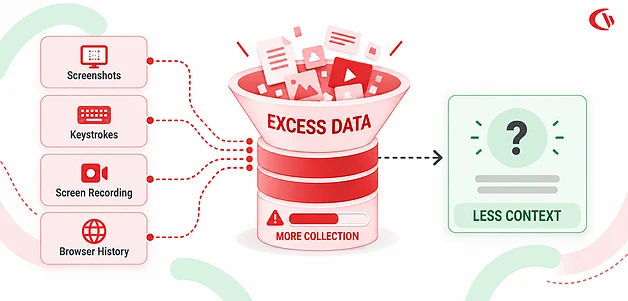
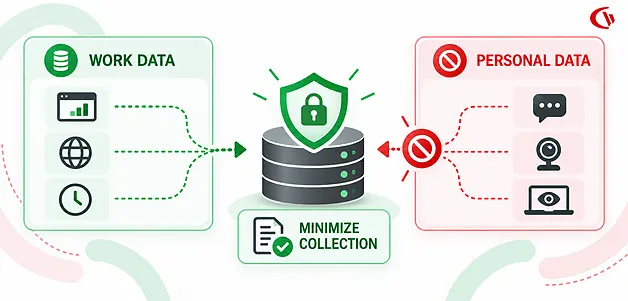
When a company gathers excessive amounts of data, it ends up with more information than is necessary, for example, things such as keystrokes, screenshots, screen recordings, and complete browser histories. The more data an organisation stores, the more severe a security incident can become and the more difficult it is to manage all that information.
-
Expanded Attack Surface
The amount of data generated by capturing keystrokes, screenshots, screen recordings, and complete browser histories is far more than most organisations need. Not only is there a problem with storage, but a paradox also emerges: the more activity data a company collects, the more difficult it becomes to manage and the less clear it becomes about what is going on from day to day.
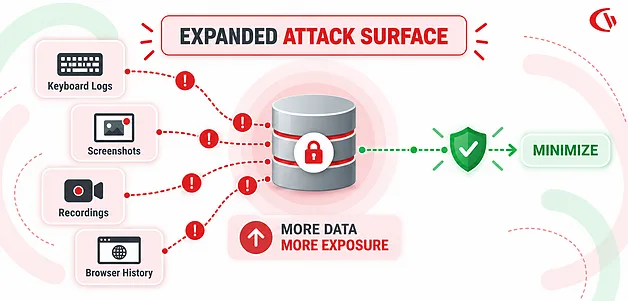
Having a large collection of unprocessed activity logs is not the same as understanding employee behaviour, and a larger dataset also means a wider blast radius should a security incident take place. -
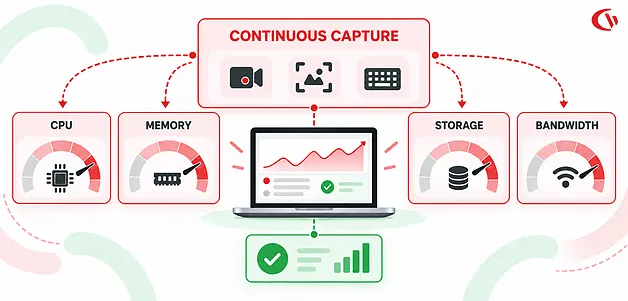
Performance & Resource Pressure
The continuous recording of screens, frequent screenshot-taking, keystroke logging, and the transmission of live data all place heavy demands on the CPU, memory, storage, and network bandwidth. This is particularly the case in shared environments such as Remote Desktop Services (RDS), Citrix, and virtual desktops.
-
Privacy and Legal Exposure
Excessive surveillance can lead to the collection of personal or sensitive information, particularly when monitoring employees at home. If this is the situation you’re in, you should review the applicable privacy and employment laws to determine the degree of monitoring that is necessary and appropriate.
 Employees’ confidence and morale may be damaged if they feel they are constantly being watched, and if they do not see a good business reason for being monitored, their engagement will drop, and the work atmosphere will be harmed.
 -
Erosion of Trust and Morale
The following two points apply in this case. On the one hand, workers who feel they are being constantly watched – without there being a clear and valid business reason for it – tend to disengage, thereby harming morale and the atmosphere of the workplace.
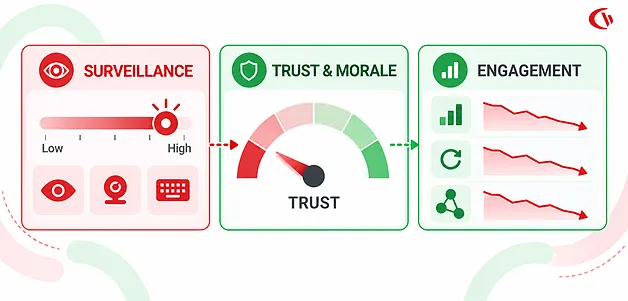 On the other hand, covert monitoring (that is, surveillance of which employees are unaware) worsens the situation by raising fundamental issues of transparency and trust between the employer and the staff.
 -
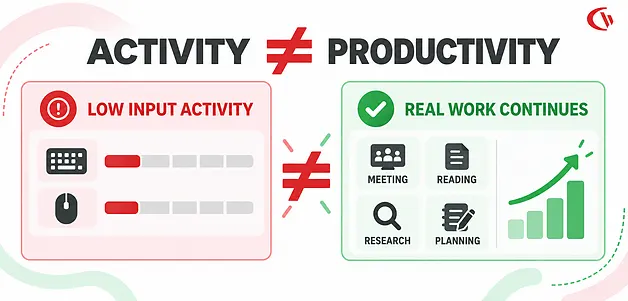
Unreliable Signs of Productivity
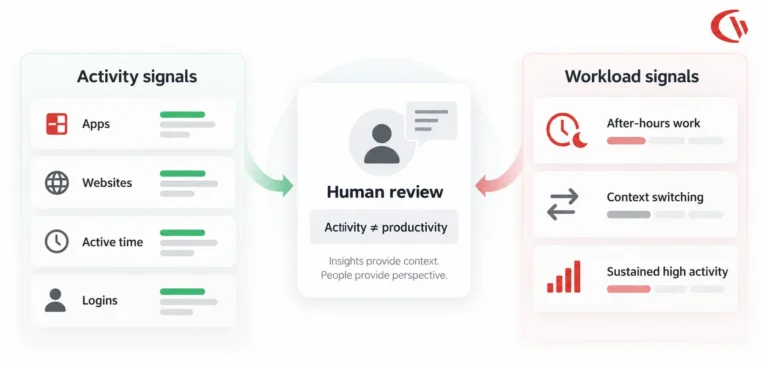
Keyboard and mouse activity is generally a weak indicator of productivity. Employees with low keyboard and mouse activity may simply be engaged in activities such as attending a meeting, reading a document, conducting research, or using a tool that requires minimal input, which should not be inferred as disengagement from work. If used as a measure of productivity, this risks false positives and unfair judgments.
Employee Sentiment: Insights from Forrester, Gartner and Harvard Business Review
Invasive workplace surveillance tends to do more damage than good to the relationship between employees and employers. Whenever companies introduce employee monitoring software for employees working from home, they have to decide how to balance the need for visibility and productivity against the need for security and the protection of employee privacy. Surveys conducted by well-known workplace and technology analysts show a growing gap between how employers handle employee monitoring and employees’ expectations.
A study by Forrester on employee privacy indicates that as many as 72% of employees worldwide oppose using their personal data for workforce analytics without their permission. The study points out a key point when it comes to introducing employee activity monitoring software: the more vague the explanation of the data that is being collected, the greater employees’ concerns will be; whereas the less anxiety the situation causes among employees, the more detailed employers are in explaining what data is being collected and why.
Gartner agrees with this conclusion. In its research into monitoring employee productivity, the company emphasises the need to explain the reasons for measuring particular activities, to select metrics that genuinely show productivity, and to communicate proactively in order to address employee concerns. Gartner states that 96% of digital workers would be more willing to accept monitoring if it offered real benefits – such as helping them to find information, providing preventive support or giving performance advice. The report also stresses the importance of being transparent about issues like when the data is collected, what specific data is collected, how long it is stored, who can access it, and for what purpose.
The Harvard Business Review also mentioned that merely increasing monitoring and surveillance is ineffective. Research conducted by the HBR has demonstrated that an excessive focus on performance measures and the close supervision of individual employees may in fact lead to a reduction in their output. Furthermore, the HBR has documented study results indicating that employee monitoring could cause a decrease in employees’ reliance on their employers and, as a result, encourage behaviour that is harmful to the organisation’s success.
2026 Compliance Requirements: EU AI Act and HIPAA Data Security
SMBs implementing remote workforce software need to be aware of the emerging legal environment in 2026, where significant compliance risks exist amid increased surveillance.
1. EU AI Act-high-risk deadline now moved to December 2027
The AI Act categorises AI systems that monitor workplaces and assess performance as “high-risk,” mandating both human monitoring and transparent data access to workers, along with transparent logging and explicit worker notice. These separate high-risk obligations originally came into force on August 2 2026.
Nevertheless, after the Council of the EU concluded the Digital Omnibus amendment on June 29 2026, payments are now due in December 2027, which takes the urgency out of the situation, even though the obligation still stands. Yet, practices which had previously been prohibited, including monitoring emotions in the workplace, came into effect in February 2025, and offences in such cases may still be punished with a fine of up to €35 million or 7% of the company’s global annual turnover in the case of the most serious violations.
2. The HIPAA Security Rule
While technically still under proposed rule status and the final rule has not passed, the U.S. Department of Health and Human Services (HHS) proposed significant amendments to this rule in January 2025, including mandatory encryption requirements, multi-factor authentication, and persistent, auditable monitoring at the endpoints.
The rule is still under review and will not be finalised by the middle of 2026, but the Office for Civil Rights (OCR) has already been actively enforcing the current rule, having issued more than $6.6 million in HIPAA penalties in 2025. In healthcare settings, any employee-monitoring tools employed must make sure that Protected Health Information (PHI) is kept secure and must not expose patient data to unnecessary screen captures or storage on third-party cloud services
3. Shadow AI and DLP risks
According to IBM’s Cost of a Data Breach Report 2025, shadow AI – unauthorised use of AI tools without employer oversight – accounted for 20% of corporate data breaches, adding an average of $670,000 to recovery costs. 97 per cent of organisations breached via AI-related incidents lacked basic access controls, underscoring the need for active endpoint data loss prevention rather than passive, blanket keylogging.
The decision will not be confirmed by the middle of 2026 and remains under consideration by the Administration, but the OCR has been actively enforcing the rule since late 2025 and handed down more than $6.6 million in HIPAA fines in 2025 as a result of breaches of the existing rule.
Evaluating Remote Workforce Software: CurrentWare vs Teramind and ActivTrak
As organizations shift away from constant monitoring and towards worker intelligence as well as proactive endpoint management, use three primary solutions for mid-market buyer comparison:
CurrentWare: Contemporary Workforce Intelligence
CurrentWare is one of the leading companies in employee monitoring and workforce analytics, and its system is especially well-suited to mid-sized businesses as well as legal and healthcare organizations concerned about endpoint security and employees’ privacy rights.
Owing to its policy-based, modular approach, small and medium-sized businesses only have to pay for the modules they need (at an average cost of $6 per module per month). The system guarantees that employees retain data sovereignty over their own personal information, which means that the vendors will not be able to access it.
CurrentWare’s suite includes:
- BrowseReporter provides transparent activity tracking and includes dashboards for workload balance.
- BrowseControl offers web filtering and allows for zero-trust application allowlisting.
- AccessPatrol gives full USB data loss prevention and hardware control.
Teramind: Deep Forensic Surveillance
Teramind’s main feature is used in areas such as identifying insider threats, conducting regulated compliance audits, or supporting legal discovery; it is by no means intended for monitoring daily workforce productivity. Even keystroke logging and live screen recordings can be searched using OCR in order to guarantee transparency in accordance with the EU AI Act.
The pricing scheme is 12 to 30 users per month (with a minimum setup of 5 users) and represents an intrusive and costly intrusion into the core of any small or medium-sized business looking to gain workforce intelligence.
ActivTrak: Cloud-First Analytics
ActivTrak’s Productivity coaching & time tracking-While less invasive than Teramind, it is the same cloud-only platform with none of the much-needed endpoint security capabilities (no on-premises hosting, no way to block USB devices, not even a way to allowlisting applications- preventing Shadow AI, critical for many security & compliance-focused businesses)
A Strategic Structure for Ethical Employee Monitoring
Here’s a framework for SMBs to use for the implementation of workplace tracking software to ensure security, productivity, and protection of company culture:
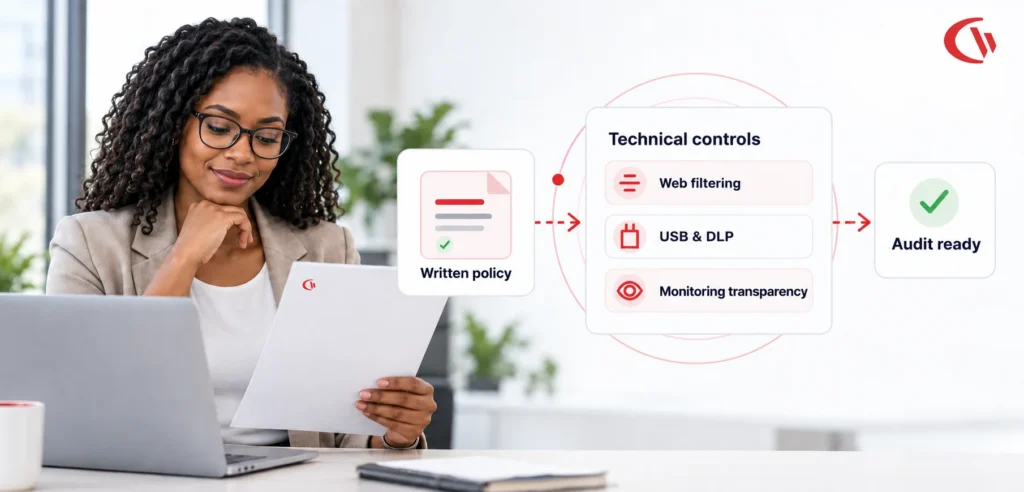
- Take a policy-driven approach to transparency by including details about the monitoring parameters in the employees’ handbooks. Present the monitoring arrangement as a means of achieving a balanced workload and helping employees with self-management rather than as a form of secret surveillance.
- Put data minimisation into practice by refusing to use keystroke loggers and continuous screen recording; restrict data collection to information about web usage at the domain level and to statistics relating to application launches in order that the personally identifiable and protected health information may be exposed as little as possible.
- Make active prevention a top priority: Introduce zero-trust application allowlisting and implement controls on USB devices in order to actively prevent malware, unauthorized shadow AI usage, and data exfiltration before breaches occur.
- Ensure data sovereignty by using solutions that provide on-premises hosting or private cloud options so that the logs of employee activity remain fully under the direct control of the company, in accordance with the NIST, HIPAA, and ISO 27001 frameworks.
Ultimately, the empirical consensus for modern SMBs in 2026 is clear: lightweight, transparent workplace-tracking software paired with proactive endpoint protection easily outperforms invasive computer-surveillance software across security, compliance, and employee-retention metrics.
Conclusion
Clearly, SMBs are trying to adapt to the hybrid workforce of 2026: the choice is simple. A transparent, policy-driven monitoring program with endpoint controls beats intrusive, policy-less spying for security, compliance, and staff trust and morale every time.
Regulatory deadliness can come and go, but the fundamental truth behind these regulations will remain the same, and businesses that design their monitoring around transparency and data minimisation will save a fortune on retooling rather than treating the solution as an espionage issue.