
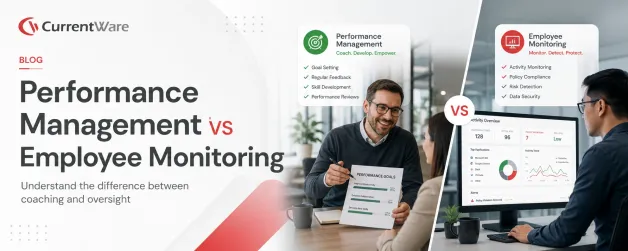

Performance Management vs Employee Monitoring – Why the Distinction Matters
Are you trying to improve employee performance or enforce workplace policies?
In today’s hybrid work world, leaders and organizations grapple with a pressing confusion: What’s the difference between monitoring tools aimed at boosting productivity and those designed to support performance development? Too often, tools and strategies blur together, with the result that employees feel watched, not supported, and managers scramble to interpret data without context.
In hybrid environments, the line between productivity tracking and performance growth gets murky. IT teams deploy monitoring tools to ensure security and visibility, while HR teams seek platforms to drive employee development and engagement. Both are valuable but different.
This article will clarify the differences between employee monitoring and performance management, explain how each serves distinct purposes, and show how they can effectively work together in a cohesive strategy.
Also Read: Employee Monitoring Software for Productivity & Security
Ready to Secure Your Data and Boost Productivity?
What Is Employee Monitoring in the Workplace?
Employee monitoring refers to the IT-led practice of collecting objective, behavioral data like app usage, browsing habits, file transfers, and desktop activity to maintain security, compliance, and operational transparency. It almost always falls under the broader umbrella of desktop monitoring and management, ensuring workplace systems are safe and efficient.
Security, Compliance, and Productivity: The Core Purpose of Employee Monitoring
• Security: Monitoring systems are critical in preventing data loss and insider threats. For example, research from the Ponemon Institute indicates that the average cost of an insider threat incident has climbed into the millions of dollars—underscoring how expensive these risks can be when unchecked.
• Compliance: Organizations use audit trails from desktop activity logs to satisfy regulations and data-protection mandates.
• Productivity: IT leaders gain high-level visibility into how work is done, spotting bottlenecks, idle time, or areas for streamlined processes, rather than micromanaging employees.
For those looking to explore specific tools, check out Employee Monitoring Software.
Also Read: What is Employee Monitoring? – Definition, Tips, and Techniques

Choose the Right Tool for the Job
For the IT-led goals of security, compliance, and risk mitigation.
- Real-time tracking
- Data for compliance and cost-saving decisions
What Is Performance Management and How It Works
Performance management is an HR-led, holistic process that emphasizes qualitative growth, continuous feedback, career development, and alignment of individual efforts with company goals.
These systems empower managers and employees to have meaningful conversations and to track progress beyond mere activity.
Core Functions of Modern Performance Tracking Software
Performance management tools typically support:
• Setting OKRs (Objectives and Key Results) and goals
• Facilitating 360-degree feedback cycles and peer reviews
• Conducting performance reviews, career development planning, and succession mapping
Performance Management vs Employee Monitoring: Key Differences Explained

To truly understand the difference, it’s helpful to compare them side by side—and recognize the distinct tech stack each belongs to: IT-driven monitoring vs. HR-powered performance.
Employee Monitoring (IT-Led) vs Performance Management (HR-Led): A Side-by-Side Table
Employee Monitoring (IT-Led) vs Performance Management (HR-Led)
| Factor | Employee Monitoring (IT-Led) | Performance Management (HR-Led) |
|---|---|---|
| Primary Goal | Security, Compliance, Risk Mitigation | Growth, Development, Goal Alignment |
| Primary Owner | IT, Security, Compliance Teams | HR, People Ops, Team Managers |
| Data Type | Objective & Behavioral: user activity logs, app usage, file transfers | Subjective & Outcome-Based: OKRs, peer reviews, manager feedback |
| Focus | How work is done (process & behavior) | What is achieved (results & impact) |
How Employee Monitoring Tools and Performance Tracking Software Work Together
Far from being competitive, employee monitoring and performance management are complementary when aligned thoughtfully.
How IT Data Supports HR Goals
Aggregated insights from tools like BrowseReporter can uncover patterns like extended after-hours work or underutilized tools that signal burnout risks or process inefficiencies. HR can use that data to start meaningful conversations around workload and support.
How HR Policies Guide Monitoring Practices
Meanwhile, HR defines the organization’s Acceptable Use Policy, outlining boundaries for privacy and professional conduct. IT then configures monitoring tools to enforce those boundaries fairly and transparently.
Also Read: Best Practices for Employee Monitoring in 2025 (Free Guide)
Best Practices for Aligning Employee Productivity Tracking With Performance Management
To foster trust and impact, organizations should follow these alignment best practices:
1. Be Transparent:
Clearly communicate monitoring policies to employees. A publicly accessible employee monitoring guide helps build trust and sets expectations for both oversight and safety.
2. Be Ethical:
Focus monitoring on business processes, not personal surveillance. Ethical monitoring practices keep the focus on corporate assets, compliance, and improving efficiency, not on scrutinizing individuals.
3. Define Roles Clearly:
• IT owns monitoring tools, configuration, and enforcement.
• HR owns performance conversations, goal planning, and development strategies.
Quick Reference: When to Use Monitoring vs Performance Management
Here’s a clear, scannable table pairing specific business scenarios with the appropriate solution:
| Scenario | Which Tool You Need |
|---|---|
| To prevent data theft via USB drives from insiders or contractors | Use AccessPatrol for controlling and securing USB access |
| To run 360-degree feedback cycles during performance reviews | Use a performance management platform |
| To understand tool and software usage patterns across your hybrid team | Use an employee productivity tracking tool like BrowseReporter |
| To track employee progress against set company OKRs or goals | Use a performance management platform |
CurrentWare’s Role in Management and Monitoring
• CurrentWare IS a workplace visibility software suite, managed by IT teams to ensure security, compliance, and productivity analysis.
• CurrentWare IS NOT a tool for performance reviews, goal setting, or employee development planning.
CurrentWare provides the essential behavioral context with activity data streams that enable HR and operations leaders to make informed, data-driven decisions. When HR sees patterns around app usage, hours worked, or process bottlenecks, they can tailor their performance frameworks and engagement initiatives accordingly.
Also Read: Software License Optimization with Cost Insights by CurrentWare
Conclusion: Choosing Between Performance Management and Employee Monitoring
To wrap up:
• Employee monitoring tools serve vital IT goal keeping systems secure, regulated, and efficient.
• Performance management tools serve HR goals driving growth, alignment, and employee success.
Leveraging both requires an understanding of their distinct purposes and the power of their synergy when thoughtfully integrated. The right tool depends on the challenge: Are you trying to safeguard data and observe work processes or empower people, guide them to goals, and help them grow?
Final Thought:
Choose the tool that aligns with your real need. If you’re safeguarding assets or ensuring policy compliance, lean on effective monitoring. If you’re cultivating performance, engagement, or career growth, invest in talent-centric performance platforms. And when you intelligently align IT and HR strategies, you build a workplace that’s both secure and high-performing.
Frequently asked
FAQs About Performance Management vs Employee Monitoring
-
Yes, by surfacing patterns like long idle times or excessive multitasking, they give HR and managers insights to intervene and support workflow improvements.
-
Depends on how it’s done. That’s why ethical monitoring practices transparency, policy-based application, and aggregated data focusing on processes, not people are essential to maintain trust.
Start minimizing your software costs today.


