What Employers Need to Know About Workforce Monitoring and California Privacy Law
Overview
Employee monitoring has become a standard practice for organizations seeking visibility into productivity, security, and operational efficiency. However, monitoring employees, especially in jurisdictions like California, requires careful alignment with privacy laws such as the California Consumer Privacy Act (CCPA) and its amendment, the California Privacy Rights Act (CPRA).
This article provides a high level overview of how employee monitoring intersects with CCPA/CPRA requirements. It is not a substitute for legal advice or a complete compliance framework.
While monitoring tools such as CurrentWare can support visibility and control, lawful implementation depends on notice, purpose limitation, necessity, proportionality, retention practices, and broader organizational governance.
CCPA vs CPRA: Current Legal Context
The CCPA, effective January 1, 2020, established baseline privacy rights for California residents. The CPRA, which became fully operative on January 1, 2023, expanded these rights and introduced additional obligations, including enhanced protections for employee data.
Today, employee personal information is fully subject to these requirements, meaning organizations must implement complete transparency, rights handling, and security obligations for their workforce
Key Privacy Principles Relevant to Employee Monitoring
Organisations implementing employee monitoring must align their practices with core privacy principles under CCPA/CPRA.
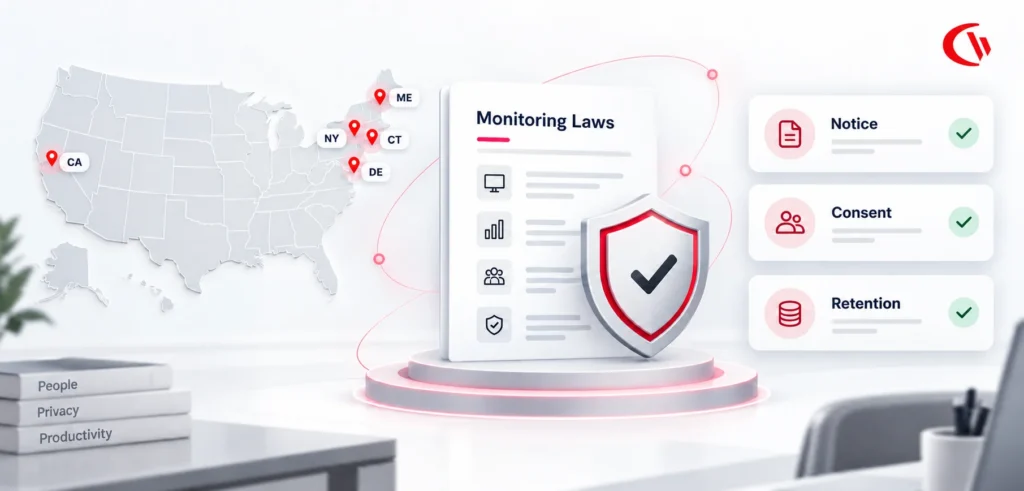
1. Notice and Transparency
Employers must provide clear and accessible notice describing:
- Categories of personal information collected
- Business or commercial purposes for collection
- Categories of recipients or disclosures
- Retention practices or criteria
This notice must be provided at or before the point of data collection and should reflect actual monitoring practices.
2. Purpose Limitation and Secondary Use Restrictions
Personal information collected through employee monitoring must be:
- Used only for specific, explicit, and legitimate purposes
- Not further processed in ways incompatible with those purposes
For example, data collected for cybersecurity monitoring should not be repurposed for unrelated employee profiling without appropriate notice and justification.
Organizations should clearly define and document permitted uses of monitoring data.
3. Data Minimisation and Proportionality
Monitoring should be limited to what is:
- Reasonably necessary and proportionate
- Relevant to the stated business purpose
This includes:
- Avoiding excessive or continuous monitoring where not justified
- Limiting data collection to specific systems, roles, or risk scenarios
- Configuring tools to exclude unnecessary categories of data
4. Retention and Deletion Governance
Organizations must implement structured retention practices, including:
- Defined retention schedules aligned to business and legal requirements
- Criteria for when monitoring data is no longer required
- Periodic review triggers to assess continued necessity
- Secure deletion or anonymisation processes
Retention should not be indefinite. Monitoring data must be retained only for as long as it is reasonably necessary for its stated purpose.
5. Security Safeguards
Businesses are required to implement reasonable and appropriate security measures to protect personal information.
This includes:
- Role-based access controls
- Monitoring and logging of administrative actions
- Protection against unauthorised access or disclosure
- Secure storage and transmission of data
See how location-based attendance tracking works in real time
Employee Privacy Rights Under CCPA/CPRA (High-Level Overview)
Employees in California may have rights under CCPA/CPRA, including:
- The right to know what personal information is collected and how it is used
- The right to request deletion of personal information, subject to applicable exceptions
- The right to correct inaccurate personal information
- The right to limit the use of sensitive personal information (where applicable)
- The right to opt-out of the sale or sharing of personal information to third parties
These rights are subject to legal exceptions and operational constraints, such as:
- Compliance with legal obligations
- Security and fraud prevention requirements
- Internal uses that are reasonably aligned with an employee’s expectations
This summary is not exhaustive and should be interpreted as a general overview rather than a complete legal roadmap.
Non-Discrimination Requirements
Organizations must not discriminate against individuals for exercising their privacy rights.
This includes avoiding:
- Denial of employment related benefits
- Reduction in service quality
- Unjustified differential treatment
Employers must uphold strict non-retaliation policies.
Breach Risk and Regulatory Enforcement
CCPA/CPRA enforcement does not operate on automatic or mechanical, however the CCPA does include a private right of action for sensitive data exposure
Regulatory outcomes depend on factors such as:
- The nature and severity of the violation
- Whether reasonable security measures were implemented
- The organization’s response to identified issues
- Evidence of good faith compliance efforts
Organizations should focus on proactive governance, documentation, and risk management. Practical Considerations for Employee Monitoring
Monitoring tools such as CurrentWare can support operational visibility, but must be deployed within a compliant framework.
Organizations should consider:
1. Defined Monitoring Policies
- Clearly documented purposes for monitoring
- Internal policies governing acceptable use
- Transparency with employees regarding monitoring practices
2. Role-Based Access and Controls
- Restrict access to monitoring data to authorised personnel only
- Implement approval workflows for sensitive data access
- Maintain logs of access and administrative activity
3. Vendor and Service Provider Governance
- Ensure contracts with monitoring software providers include appropriate data protection terms
- Define roles (business vs service provider) under CCPA/CPRA
- Validate security and processing practices of vendors
4. Rights Handling Workflows
- Establish processes for responding to access, deletion, and correction requests
- Verify identity before fulfilling requests
- Document responses and decision-making processes
5. Sensitive Personal Information Governance
Where monitoring may involve sensitive personal information:
- Limit collection and use to what is strictly necessary
- Apply additional safeguards and access restrictions
- Provide appropriate notices and controls
The Role of Monitoring Software in Compliance
Monitoring software can support compliance efforts by enabling:
- Visibility into workforce activity
- Detection of potential policy violations or risks
- Audit trails for internal investigations
- Enforcement of acceptable use policies
However, technology alone does not ensure compliance.
Lawful monitoring requires:
- A valid legal basis and documented purposes
- Transparent communication with employees
- Proper configuration of monitoring tools
- Strong organisational policies and governance
- Ongoing review and accountability processes
Important Disclaimer
CurrentWare can support elements of an organisation’s privacy, security, and governance framework.
However, the use of monitoring software does not, by itself, ensure compliance with CCPA or CPRA.
Compliance depends on:
- Implementation choices and configuration
- Organisational policies and controls
- Legal interpretation of applicable obligations
- Ongoing governance and oversight
Organisations should consult qualified legal and privacy professionals when designing and implementing employee monitoring programmes.
Conclusion
Employee monitoring in the CCPA/CPRA era requires a balanced approach—one that enables visibility and operational control while respecting privacy rights and legal obligations.
Organisations that succeed in this space focus on:
- Clear purpose definition
- Proportionate and necessary data collection
- Strong governance and accountability
- Transparent communication with employees
When implemented within a structured compliance framework, monitoring tools like CurrentWare can play a supporting role in achieving these objectives.
Track employee attendance without invasive GPS monitoring