In most organizations, the largest line item on the balance sheet isn’t technology, it’s people.
Labor accounts for 70% of total operating expenses in most SaaS businesses, yet executives often lack a clear view of how that investment translates into productivity, risk exposure, software utilization, and operational efficiency.
At the same time, organizations are facing a new wave of hidden costs:
- Insider threats
- Shadow IT and uncontrolled AI usage
- Underutilized SaaS licenses
- Workflow inefficiencies across digital tools
Individually, these seem manageable. Collectively, they drain hundreds of thousands of dollars annually from operating budgets, and more importantly, they introduce unquantified risk.
How can workforce visibility drive measurable business ROI?
“We realized we’d been deploying applications to everyone, even when they didn’t need them. With Cost Insights, we saw who hadn’t touched a tool in months and saved over $10,000 just by right-sizing our licenses.”
Adam Martin, Information Security Systems Engineer, Sentry View Systems
The Workforce Visibility Gap That Costs Organizations Thousands of Dollars
According to Gartner, organizations are increasingly struggling with the “visibility gap” in digital workforce operations, where leaders cannot accurately correlate workforce behavior with productivity, risk exposure, and technology spending.
In security terms, this is a control gap. You cannot secure, optimize, or govern what you cannot see.
The financial implications are already well documented:
- IBM Security reports the average cost of a data breach at $4.45 million, with insider related incidents among the most expensive due to investigation time and containment complexity.
- Forrester estimates that ~30% of enterprise SaaS spend is wasted, primarily due to lack of usage visibility.
Workforce Intelligence: Turning Activity Data Into Business Decisions
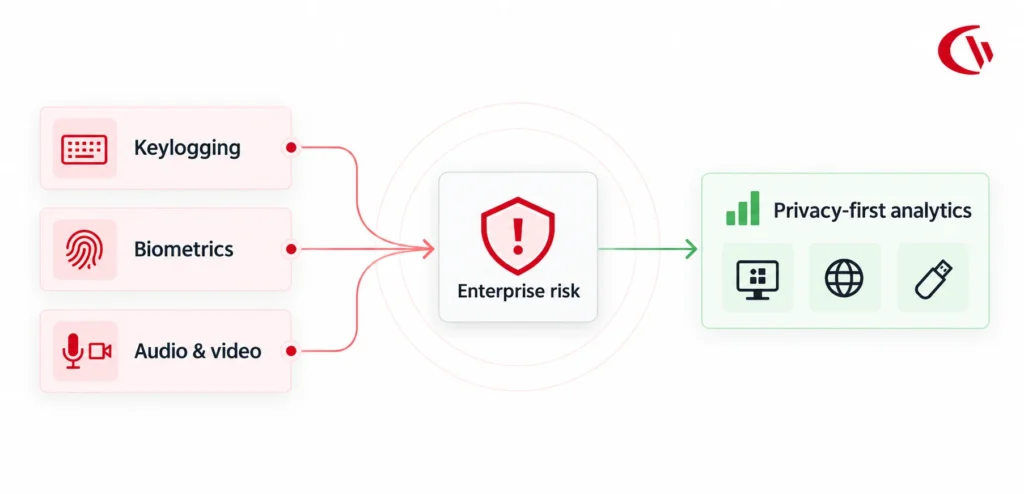
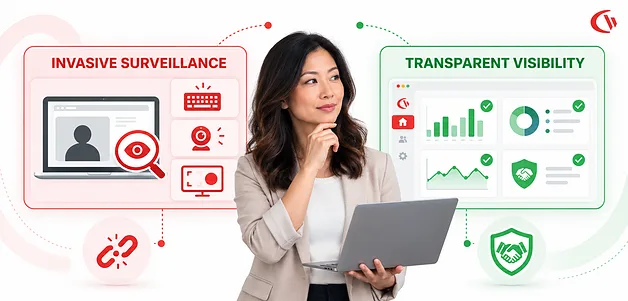
Most “employee monitoring” conversations are framed incorrectly. Security leaders are not looking for surveillance. They are looking for operational intelligence and control validation.
The real questions sound like this:
- Where is data moving in ways we didn’t intend?
- Which users are operating outside expected behavior patterns?
- Which tools are in use and which are just expanding the attack surface?
- Where is AI usage introducing data exposure risk?
This is where workforce visibility becomes strategic.
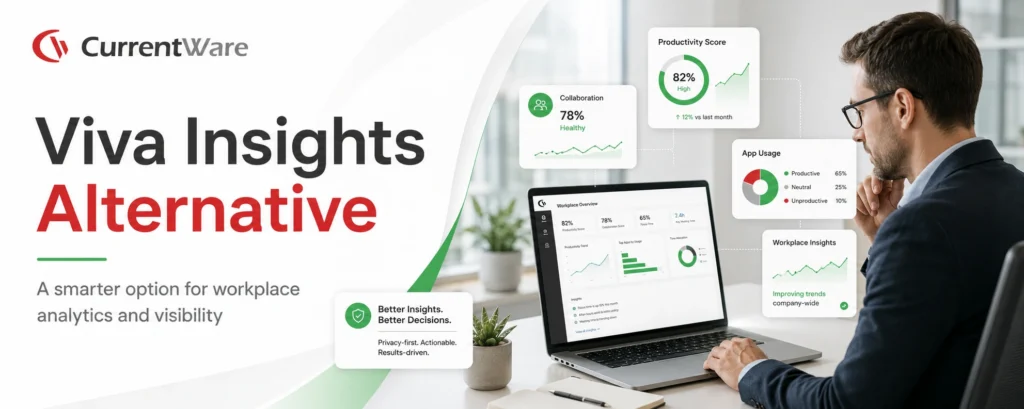
CurrentWare approaches this challenge through endpoint visibility and workforce analytics. The result is not surveillance. It is productivity visibility. CurrentWare helps by:
1. Turning Workforce Visibility Into Measurable Software Savings
The SaaS stack grows faster than governance. It’s lack of usage level visibility post deployment.
As one customer put it:
“We discovered a $180,000–$200,000 annual software waste simply because we could finally see what wasn’t being used.”
Once visibility is introduced, the actions are straightforward:
- Eliminate redundant tools
- Reallocate licenses
- Consolidate platforms
This is why software optimization consistently becomes: The first and fastest ROI win
(Based on CurrentWare ROI Calculator Benchmarks)
For a typical mid sized organization with 200 employees, workforce visibility directly translates into measurable cost savings across software spend.
Baseline SaaS Investment
- Average SaaS spend per employee: $4,830 annually
- Total annual SaaS spend: 200 × $4,830 = $966,000 per year
Hidden Cost: Unused & Underutilized Licenses
- Industry benchmark: ~30% of SaaS licenses go unused
- Estimated annual waste: $966,000 × 30% = $289,800 lost annually
Realistic Savings Opportunity. Even with a conservative recovery approach:
- Reclaiming just a portion of unused licenses results in: $60,000 – $90,000 in annual savings
Executive Takeaway
This is immediate, balance sheet impact, achieved by turning workforce activity data into actionable decisions on software spend, utilization, and operational efficiency.
As one enterprise IT leader put it:
“We realized we were deploying applications to everyone by default. Once we saw actual usage, it was obvious—people hadn’t touched some tools in months. We right-sized licenses and the savings were immediate.”
2. Reducing Breach Costs Through Insider Risk Visibility
One of the most immediate ROI drivers for workforce intelligence is risk reduction. According to research published by the Ponemon Institute, insider incidents cost organizations an average of $15.4 million annually, driven largely by investigation time, operational disruption, and compliance exposure.
Platforms like CurrentWare reduce this risk by providing visibility into:
- risky file transfers
- unauthorized data movement
- abnormal user activity patterns
- potential policy violations
Preventing even a single breach or compliance failure can justify the investment many times over.
3. Improving Productivity Through Workforce Visibility
Another major ROI driver is workforce efficiency. Without clear insight, leaders struggle to answer key questions:
- Which applications create workflow bottlenecks?
- Where do employees lose time across systems?
- Which teams operate below capacity?
CurrentWare enables organizations to see:
- how time is spent across applications
- which tools drive productive workflows
- where employees encounter friction
“Before CurrentWare, we struggled with visibility. Now we have control and visibility.”
And perhaps the most telling summary:
“Control, visibility, compliance, at a cost that makes sense. If you don’t know what’s happening, it will haunt you later.”
It’s a must have. Period
4. Governing AI Adoption Without Slowing Innovation
The rapid adoption of generative AI tools has created a new visibility challenge. Employees increasingly experiment with AI platforms such as chatbots, copilots, and automated research tools, often without formal governance policies.
According to analysis from IEEE, unmanaged AI adoption can expose organizations to data leakage, intellectual property risks, and compliance violations. At the same time, AI tools can dramatically increase productivity. This creates a delicate balance for leadership: Encourage innovation while maintaining governance.
CurrentWare provides visibility into AI tool usage patterns across the workforce, allowing organizations to:
- identify shadow AI usage
- monitor potential data exposure risks
- differentiate productive AI adoption from risky behavior
5. Reducing Compliance Burden and Audit Risk
Compliance requirements continue to grow across industries, particularly in sectors such as:
- finance
- healthcare
- legal services
- government contracting
Yet many compliance frameworks require organizations to demonstrate policy enforcement and operational oversight. Workforce intelligence platforms streamline this process by providing:
- centralized activity reporting
- policy enforcement visibility
- Audit ready monitoring data
Turning Workforce Visibility Into Business ROI
CurrentWare enables leaders to generate ROI across multiple business dimensions:
| Business Objective | How Workforce Visibility Helps |
|---|---|
| Risk reduction | Detect insider threats and prevent costly breaches |
| Productivity improvement | Identify workflow inefficiencies and optimize labor utilization |
| Software cost control | Reveal underused tools and eliminate license waste |
| AI governance | Monitor AI usage while encouraging productive adoption |
| Compliance readiness | Simplify audits and demonstrate policy enforcement |
| Operational efficiency | Reduce manual oversight and improve decision-making |
To Conclude
Leadership decisions increasingly depend on operational clarity. Workforce visibility connects routine user activity with high level business outcomes, across cost, productivity, risk, and compliance. And in a world where people represent the largest operational investment, that visibility is no longer optional.
What Is Your Visibility Gap Costing You?